The protein that feels thirst: SAM8 as a molecular water sensor
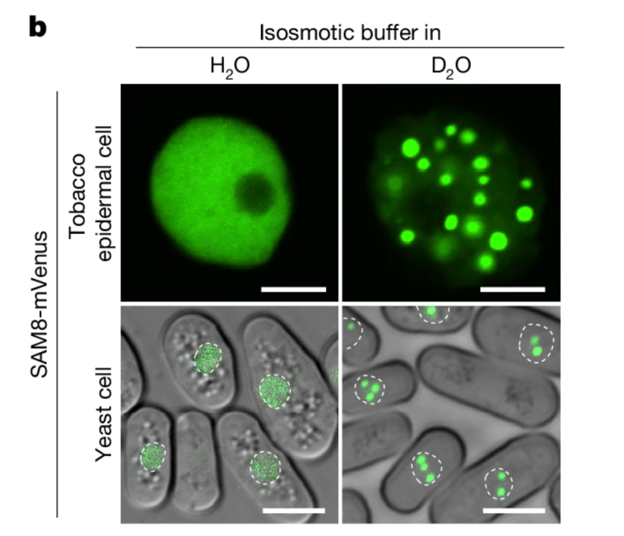 How a cell detects a drop in water potential, the physical signal of drought or salinity, has been a long-standing puzzle. Wang et al. identified SAM8, an Arabidopsis protein that reversibly condenses into nuclear droplets when cellular water becomes scarce. When water is freely available, a negatively charged disordered region surrounds SAM8 with a thick hydration shell that keeps it dispersed in the solution; when water potential drops from osmotic stress or seed desiccation, the hydration layer thins and the protein reversibly phase-separates within minutes. The authors confirmed this behavior by using purified protein in vitro, showing that crowders like PEG, which sequesters water, triggers this condensation while a same-sized crowder that does not lower water potential leaves the SAM8 dispersed. The condensed SAM8 droplets selectively trap mRNA export factors from the ALY family, holding messenger RNAs in the nucleus and reprogramming translation toward stress-response transcripts rather than growth genes. Plants that lack SAM8 are hypersensitive to osmotic stress and germinate poorly, and the sensitivity threshold tracks with a species drought tolerance, pointing to a conserved, tunable mechanism for balancing growth against water stress. (Summary by Trevor Melusen) Nature 10.1038/s41586-026-10591-8.