
Evidence for C4 photosynthetic fluxes in transgenic rice plants
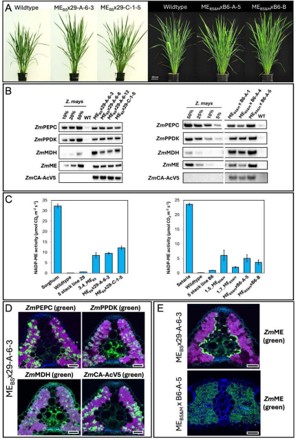 Improving photosynthetic efficiency is an important strategy to boost yields in staple crops such as rice, which relies on the relatively inefficient C3 pathway. In contrast, C4 photosynthesis minimizes photorespiration through a carbon-concentrating mechanism, making it more productive under high-light and high-temperature conditions. Engineering C4 traits into rice has long been a major goal, but progress has been limited by the complexity of coordinating biochemical reactions with the leaf structures specific to C4 pathways, such as bundle sheath cells. In this study, Baccolini et al. developed improved transgenic rice lines expressing key C4 enzymes and used pulse-chase experiments to detect metabolic flux within the pathway. The authors provide clear evidence that multiple core C4 reactions are operational in these engineered plants, including the three central steps of the C4 cycle and CO₂ refixation, indicating coordinated metabolic activity within a C3 background. Importantly, this work moves beyond proof-of-expression toward proof-of-function, demonstrating that C4-like biochemical flux can occur in rice despite the absence of specialized C4 anatomy. This study represents a significant step toward developing high-yielding, climate-resilient crops that can sustain global food production under increasingly challenging environmental conditions. (Summary by Fatai Ayomide Akande) bioRxiv 10.64898/2026.05.28.728371