

CP26 has a structural role in non-photochemical quenching
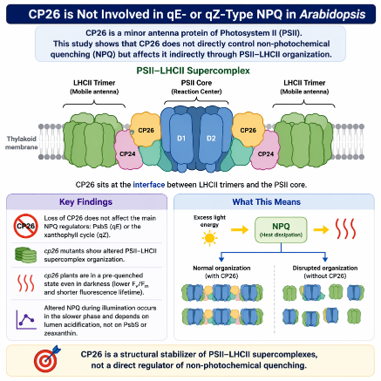 Plants protect themselves from excess light by safely dissipating extra energy as heat through a process called non-photochemical quenching (NPQ). Several proteins are known to control this process, but the role of the antenna protein CP26 has remained unclear. In this study, Walter et al. used Arabidopsis mutants lacking CP26, alone and in combination with other key NPQ regulators, to investigate its function. Walter and colleagues found that plants without CP26 behave differently from normal plants. Even in darkness, these plants were already in a “pre-quenched” state, meaning their photosystems were less efficient before light exposure. Under high light, they also showed altered NPQ responses, particularly during the slower phase of energy dissipation. However, these changes were not driven by the main NPQ components, including the PsbS protein and the xanthophyll cycle, which are typically responsible for fast and slow NPQ, respectively. Instead, the results suggest that CP26 does not directly control NPQ. Rather, its absence disrupts the organization of protein complexes in the chloroplast, which indirectly affects how energy is dissipated. Overall, this study clarifies that CP26 is not a core regulator of NPQ but plays an important structural role in maintaining efficient photosynthesis. Understanding these structural effects helps refine our knowledge of how plants balance light capture and protection. (Summary by Fatai Ayomide Akande) Plant Physiology 10.1093/plphys/kiag207

