Discovery and engineering of synthetic RLKs
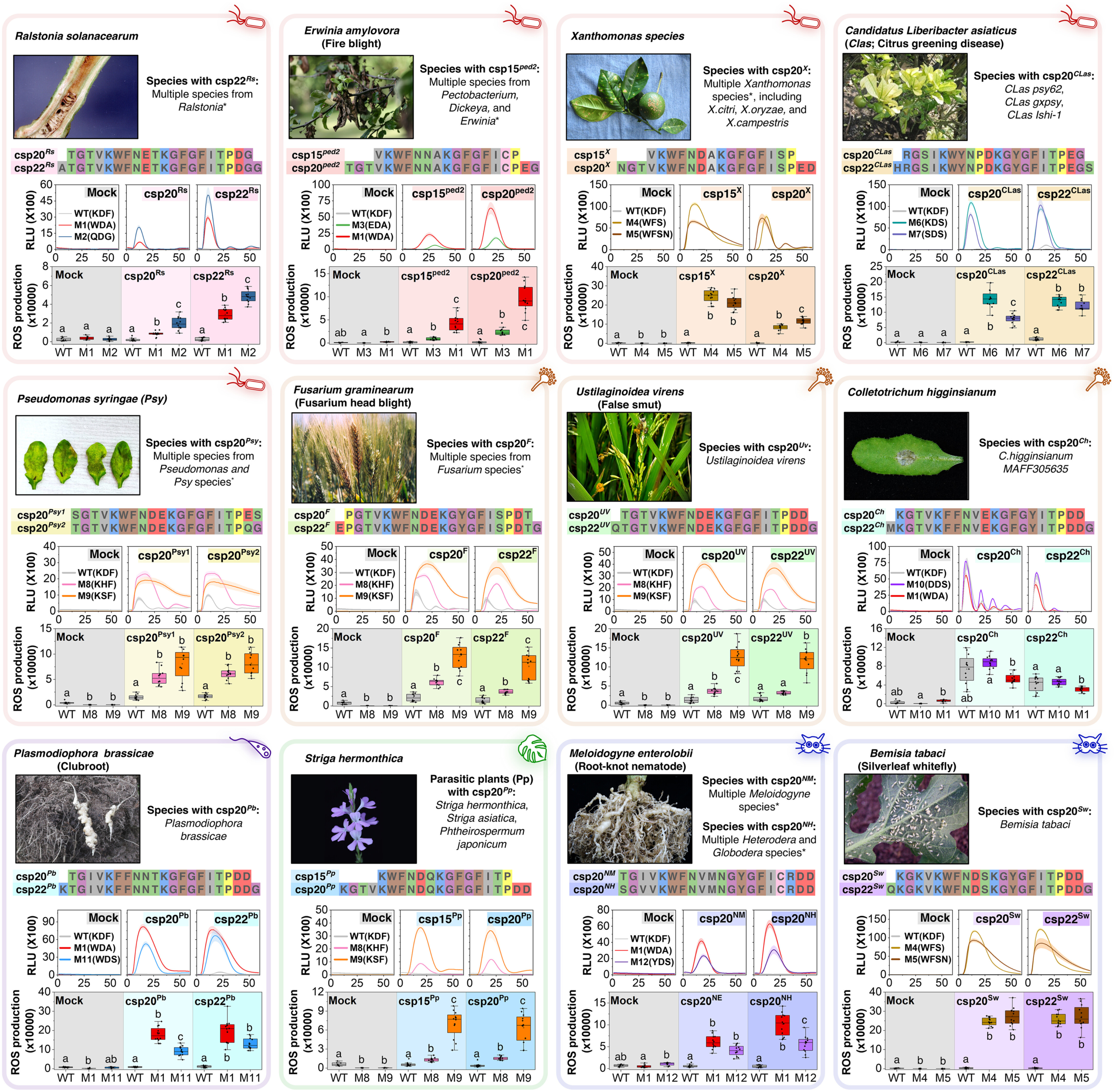 Receptor-like kinases (RLKs) are abundant genes that have diversified and expanded throughout plant evolution, with most plants having hundreds or more RLKs. In this exciting new paper, Ngou et al. decided to deconstruct the recognition sites of these proteins in order to be able to make predictions about their ligands. Focusing on the LRR-RLK-XII family that encodes the familiar RLK FLS2, they clustered the sequences of the extracellular recognition domains from 13,185 genes from 350 plant genomes, and identified 210 subgroups with distinct binding domains likely to recognize different ligands, and characterized representatives for their ability to recognize live or boiled bacterial extracts in vivo. They then focused on a candidate that recognized extracts from multiple bacteria, and worked out that it recognizes a peptide csp15 from cold-shock proteins; they designated this protein SCORE (selective cold shock protein receptor). They dissected the LRR domain and identified regions that recognize different cold-shock proteins. Next they looked at the interaction between 21 SCORE orthologues versus 104 diverse csp15 peptides to map the LRR amino acids responsible for SCORE specificity. With this knowledge in hand, they designed a synthetic SCORE that recognizes a wide range of bacterial cold-shock proteins, raising the possibility of introducing broad-spectrum resistance to crops. This is truly a “wow” paper representing an impressive amount of work and valuable findings. You can also read the very helpful illustrated summary on the first author’s Bluesky account here https://bsky.app/profile/brunongou.bsky.social/post/3lkmktd3ezs2g. (Summary by Mary Williams @PlantTeaching.bsky.social) Science https://10.1126/science.adx2508.