
Benzoxazinoids (BXs) modulate soil microbiota to promote foliar disease resistance
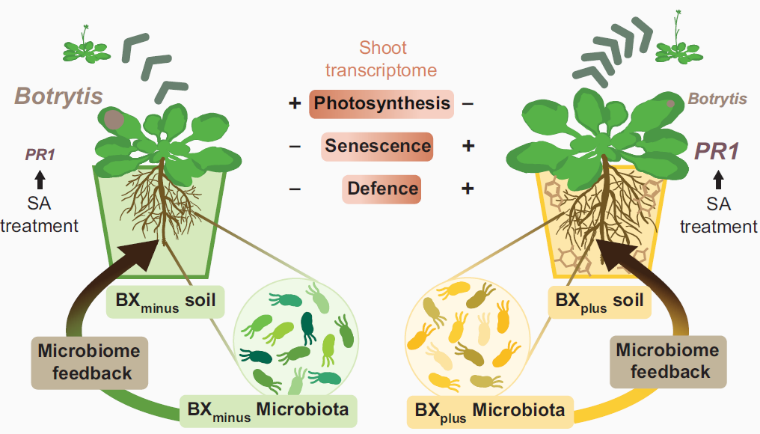 Plant roots exude organic compounds such as benzoxazinoids (BXs) to the surrounding soil. BXs modulate soil microbiota, which in turn regulate plant growth. In this study, Stengele et al. show that BX-modulated soil microbiota also promote plant immunity. The authors first pretreated soil with BXs by growing BX-secreting maize. They then used this BX-pretreated soil to grow Arabidopsis. The BX-conditioned soil showed altered root microbiota and promoted foliar disease resistance of the Arabidopsis plants. Transcriptome profiling revealed that plants grown in the BX-conditioned soil exhibited elevated expressions of defense marker genes in the shoots even without pathogen attack. Furthermore, these plants were more responsive to the defense hormone salicylic acid (SA). To test whether the enhanced disease resistance was directed by BX, the authors exposed Arabidopsis roots to BX. However, this treatment alone did not promote disease resistance, suggesting that the effect is mediated by changes in the soil microbiota. Taken together, the study concluded that BXs reshape soil microbiota which exerts an SA-dependent priming effect to promote plant immunity. This study by Stengele et al. advances our understanding of long-distance signalling and priming effect, highlighting the application potential of crop rotation to promote plant health. (Summary by Yee-Shan Ku @Yee-Shan Ku) New Phytologist 10.1111/nph.71098