Genomic studies offer new hope for restoring the dwindling American chestnut
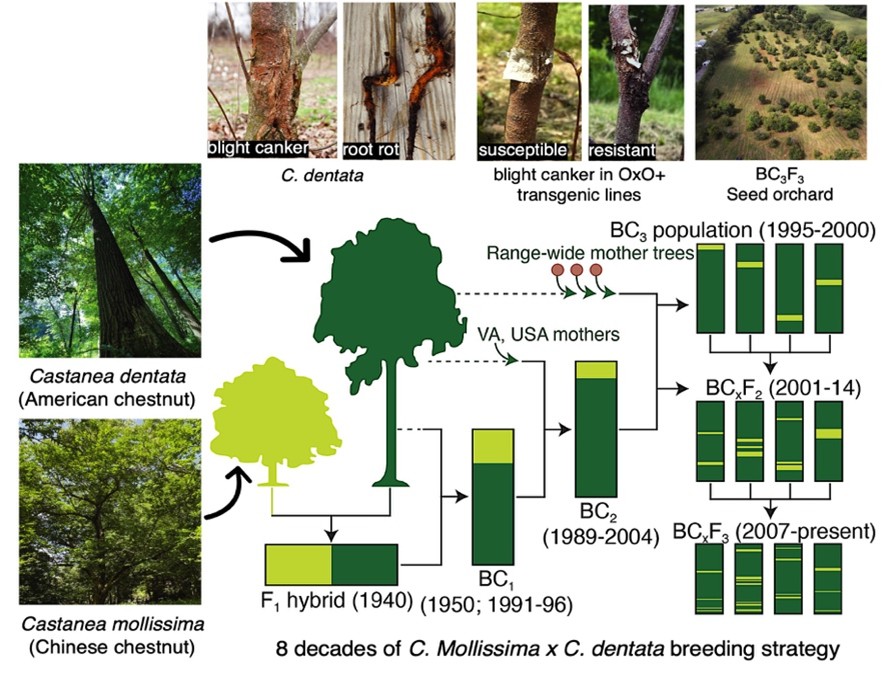 Deadly blight caused by the fungal pathogen (Cryphonectria parasitica) and root rot caused by an oomycete pathogen have pushed the American chestnuts toward extinction. In this study by Westbrook et al., the authors highlight the ongoing restoration strategies aiming to return the previously dominant American chestnut to its native range. The authors implemented a multi-strategic approach, including hybridization with resistant Chinese chestnuts, backcrossing and intercrossing to improve blight resistance in the American chestnut. The authors also evaluate the performance of transgenic lines overexpressing oxalate oxidase (OxO), which degrades a fungal virulence factor. Although this transgene provides significant protection, a broad genetic foundation from diverse breeding populations remains essential for long-term survival. The authors developed a chromosome-scale genome for the chestnuts to overcome the molecular limitations of breeding strategies. They report that although most protein-coding genes are shared across species, extensive copy number variation (CNV) in the Chinese chestnut contributes significantly to its superior immunity. Through RNA sequencing, they found that resistant trees have constitutively upregulated biosynthesis of certain metabolites, particularly lupeol, a triterpene sterol that actively inhibits fungal growth. Using quantitative trait loci (QTL) mapping, the authors found that blight resistance is controlled by a network of numerous small-effect QTLs. They conducted a genome-wide association study (GWAS) across 3365 hybrid trees to further detect blight resistance-associated loci. Despite selection for blight resistance, substantial root rot resistance was also inherited in the hybrid population, indicating multilocus resistance. The authors propose recurrent selection strategies within hybrid populations as a key approach to enhance disease resistance and forest competitiveness, emphasizing that successful restoration requires selecting hybrid trees with roughly 70-85% American chestnut ancestry. (Summary by Sonal Sachdev @sci3ntyst @sci3ntyst.bsky.social) Science 10.1126/science.adw3225