The last one standing: A point mutation that suppresses the lazy quadruple mutant phenotype
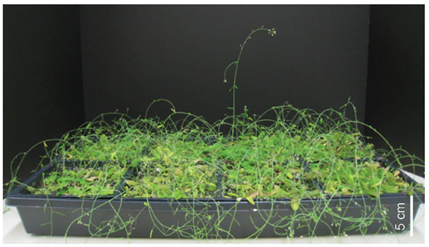 Gravity is perceived by amyloplast sedimentation in gravity-sensing cells, a process relying on the relocalization of LAZY proteins from the amyloplast to the plasma membrane. Increasing evidence has emerged on this new aspect of gravity sensing, and in this recent publication, Yoshihara and Spalding highlight a new component of the pathway. The lazy1234 quadruple mutant shows an antigravitropic phenotype, where the shoot grows downward and the root grows upward relative to the gravity vector. A suppressor screen therefore is quite straightforward, selecting for shoots growing straight upward. This screen identified suppressor of lazy quadruple mutant 1 (slq1), in which the asymmetric auxin distribution, quantified by the expression of IAA5 in the upper and lower sides of the stem, was partially restored. Introducing a point mutation (S149F) disrupts SLQ1’s subcellular localization, dimerization, and supramolecular structure. A homologous protein, SETH6, colocalizes with SLQ1 and is required for proper supramolecular assembly of SLQ1. Another piece of the LAZY puzzle found! (Summary by Sophie Zoe Farkas @sophiezoe.bsky.social) PNAS 10.1073/pnas.2510934122