The hidden power of water in plant regeneration
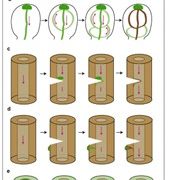
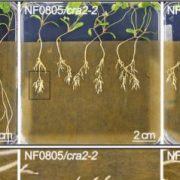
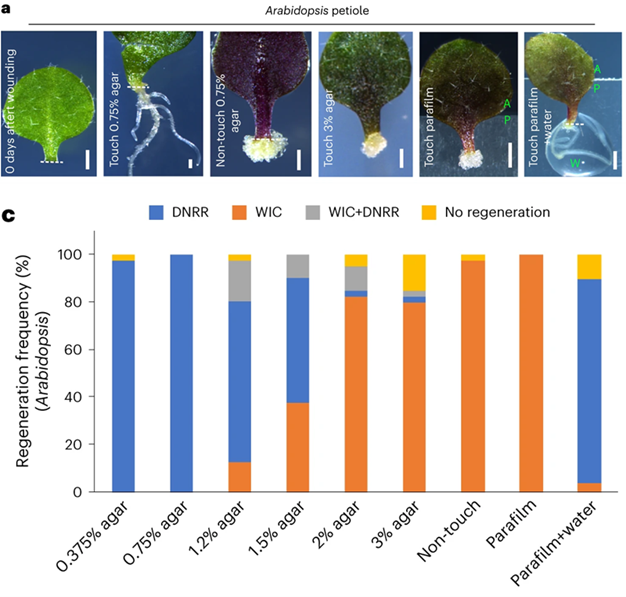 Plants are renowned for their remarkable ability to regenerate tissues and organs. Two typical regeneration pathways—de novo root regeneration (DNRR) and wound-induced callus (WIC) formation—enable recovery from injury but involve entirely different cell fate outcomes. These processes also form the foundation for tissue culture techniques used in plant transformation. A simple yet often overlooked factor that determines regeneration efficiency is water availability. To illustrate this, Kareem and colleagues used detached Arabidopsis leaves—which rely heavily on water signals to maintain cell viability—to investigate the key determinants of regeneration outcomes. One might expect that physical contact and nutrient availability from the culture matrix would promote DNRR. Surprisingly, however, the authors found that either non-contact conditions or contact with a 3% agar matrix (low water availability) led to WIC formation, but not root regeneration. In contrast, contact with a 0.75% agar matrix (high water availability) or direct water supply successfully induced DNRR. These findings reveal that water availability is a major factor dictating plant regeneration fate. Through a combination of reporter lines, mutants, and microscopy, the authors further demonstrated that external water signals are integrated into the auxin signaling cascade, triggering polar auxin transport and ultimately determining whether root regeneration or callus formation occurs at the wound site. (Summary by Ching Chan @ntnuchanlab) Nature Plants 10.1038/s41477-025-02029-2