Gas as a messenger: How plants monitor their barriers
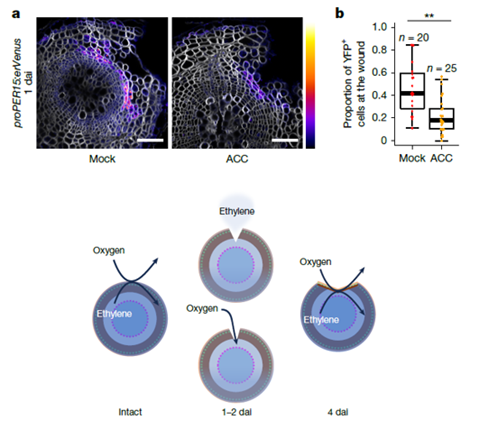 The periderm is a protective outer tissue formed during secondary growth in many seed plants, serving as a barrier against water loss and pathogen invasion. When damaged, it can regenerate to restore its protective function. However, the molecular and cellular mechanisms underlying periderm regeneration remain poorly understood. In this study, Iida et al. investigated periderm regeneration in Arabidopsis thaliana, examining morphological changes, periderm-specific gene expression, and the functionality of the re-established barrier after wounding. The authors found that ethylene signalling negatively regulates periderm regeneration. Treatment with ACC, an ethylene precursor, reduced the expression of key periderm genes and impaired the formation of suberized cell layers. Wounding caused a decrease in ethylene signalling, as ethylene gas diffused out through the injury site. This loss of ethylene appeared to initiate regeneration, and sealing the wound to block gas escape suppressed this response. However, since ethylene alone did not fully inhibit regeneration, the authors investigated the role of oxygen. Using hypoxia-responsive reporters and oxygen microsensors, they showed that wounding allows oxygen to enter the tissue, reducing hypoxia signalling and promoting regeneration. Through gene expression analyses and chemical treatments, they demonstrated that ethylene and hypoxia signalling act additively to inhibit regeneration, and that restoration of the barrier limits gas diffusion, helping terminate the regenerative process. Finally, similar gas-mediated monitoring was observed in wounded inflorescence stems, though possibly involving other volatile signals. Together, these findings reveal a novel gas-based mechanism for monitoring barrier integrity in plants, where ethylene and oxygen create a permissive environment for regeneration, likely acting together with cues from peptides, hormones, or mechanical stress. (Summary by Elisa De Meo, www.linkedin.com/in/elisa-de-meo-25415a20b) Nature, 10.1038/s41586-025-09223-4