Local CLE peptides promotes rapid, ABA-independent stomatal closure
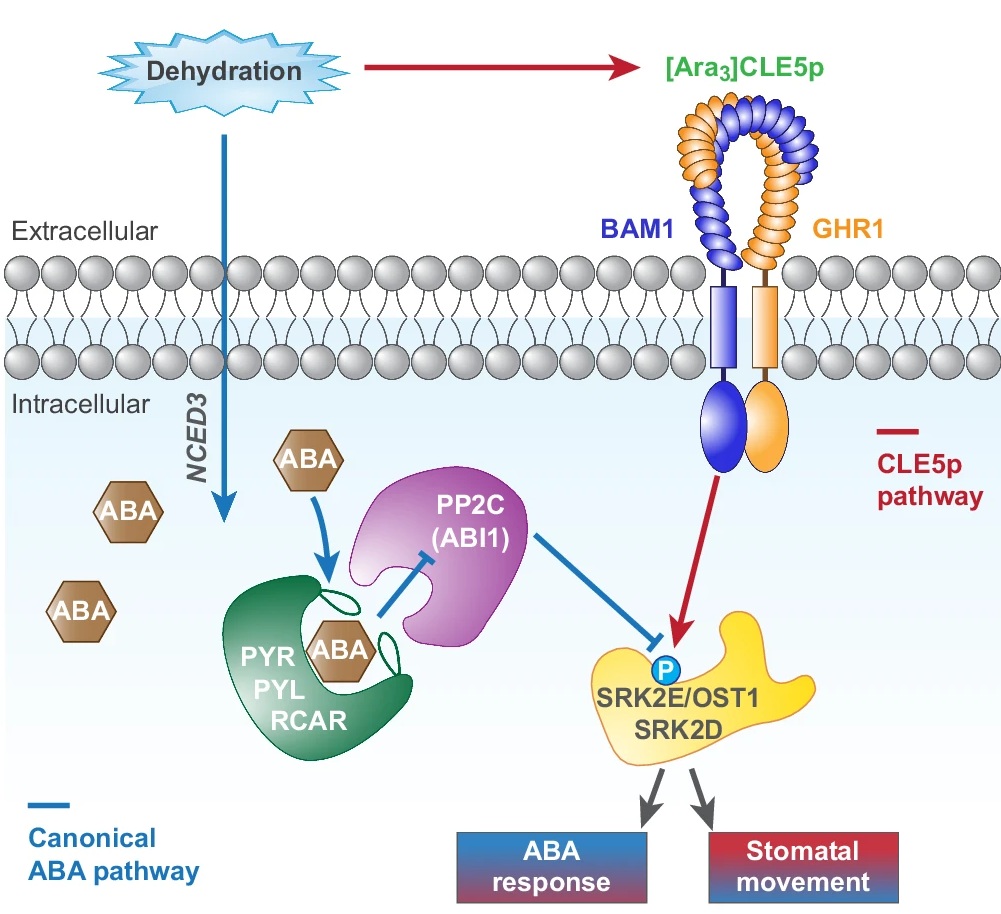 Guard cells might be some of the most well-characterized plant cells due to their accessibility, their importance in land plant survival, and their easily measured responses. Guard cells respond to several signals including light, CO2, vapor pressure deficit, ROS, and abscisic acid (ABA), which acts through a conserved a signaling cascade involving PYRs, PP2Cs, and SnRKs. Recently, the peptide CLE25p was identified that is produced in drought-stressed roots and is transported to leaves to promote guard cell closure. Following up on this work, Shimotohno et al. looked at stomatal responses across mutants of several other CLE peptides. They found that loss-of-function mutants of CLE5 show very high drought sensitivity, and that the CLE5 gene is rapidly induced by drought stress in leaves and guard cells. Interestingly, plants over- or under-expressing CLE5 have normal ABA levels, indicating that CLE5 does not act through ABA, although it does induce ABA-inducible genes. This signaling pathway is in contrast to that of the root-borne CLE25p signal, which acts by inducing ABA synthesis. Thus, CLE5 is a rapid, local drought-responsive signal that induces stomatal closure. (Summary by Mary Williams @PlantTeaching.bsky.social) Nature Comms. 10.1038/s41467-025-66392-6