
Commentary. Peptide-based biostimulants in sustainable agriculture: opportunities and innovations
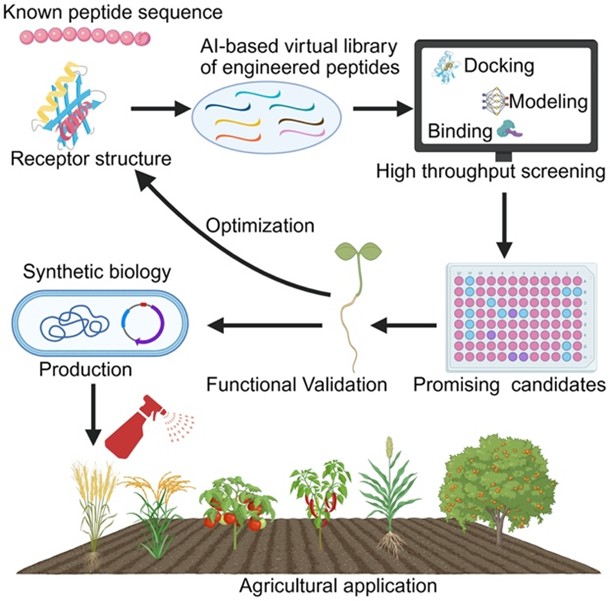 Naturally occurring biostimulants have emerged as promising tools for promoting sustainable agriculture and horticulture by enhancing plant performance while reducing reliance on chemical inputs. Among these, peptide-based biostimulants stand out for their high specificity, biodegradability, and overall environmental friendliness, making them attractive candidates for next-generation crop management strategies. Hu and colleagues highlight the remarkable flexibility of engineered peptides using CLAVATA3 (CLV3) and EMBRYO SURROUNDING REGION RELATED (CLE) peptides as a showcase. Through rational reconstruction via mutation, insertion, deletion, or the creation of peptide chimeras, CLV3/CLE peptides can be tailored to elicit diverse and highly targeted biological outcomes. For example, arabinosylation-modified CLV3/CLE peptides act as agonists that promote root growth inhibition. In contrast, substituting the conserved glycine residue within the CLE motif generates antagonistic peptides that enhance primary root elongation and increase lateral root density. Notably, a chimera between CLV3 and CLE25 can be perceived by both receptors, enabling simultaneous regulation of stem cell homeostasis in the apical meristem and the cambium. Despite these advantages, peptide-based biostimulants face limitations, including instability and poor cellular permeability. Looking ahead, the integration of advanced machine learning tools for high-throughput peptide design and screening promises to accelerate innovation, paving the way for more robust, precise, and scalable peptide biostimulants in sustainable plant production systems. (Summary by Ching Chan @ntnuchanlab @ntnuchanlab.bsky.social) J. Integr. Plant Biol. 10.1111/jipb.70093