
When plants feel the bite: Mechanoperception and systemic defense signaling
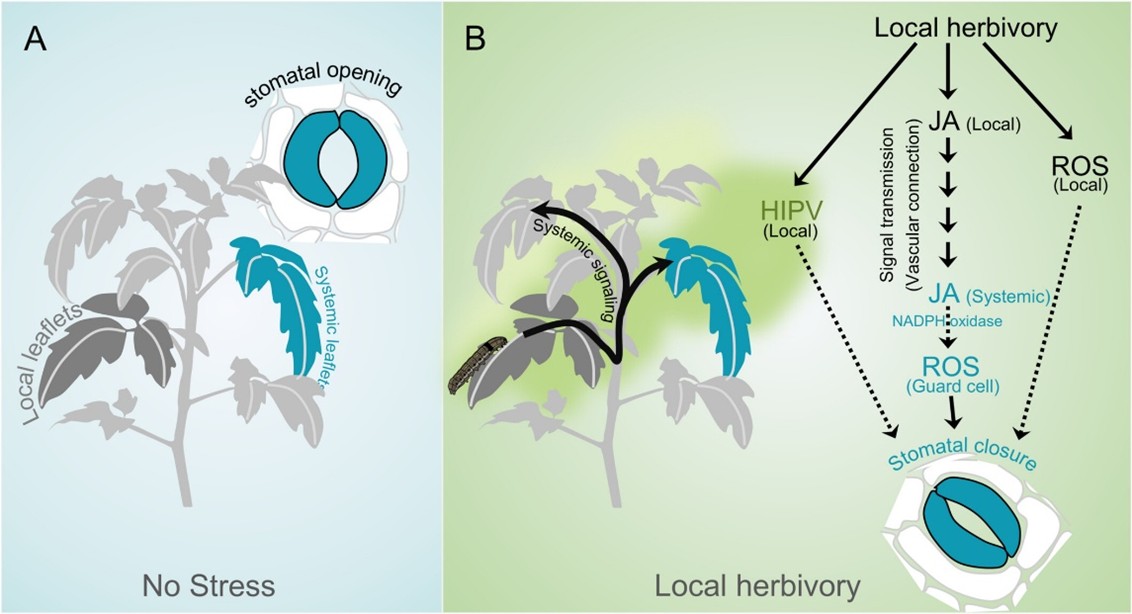 Plants may appear silent, yet they can rapidly perceive and respond to environmental challenges. Despite lacking sensory nerve cells like animals, plants rely on mechanoperception to detect stimuli such as touch, wind, and herbivore attack. This framework has led researchers to uncover how mechanical cues are perceived, integrated into defense signaling networks, and transmitted over long distances via molecular sensors and electrical signaling processes. A rapid, systemic downregulation of photosynthesis is a well-known hallmark of herbivore attack. Lin and colleagues reveal that this response is largely driven by stomatal closure, triggered by insect-derived cues combining wounding and oral secretions (WOS). To dissect the underlying mechanisms, the authors evaluated several potential causal factors, including herbivore-induced plant volatiles (HIPVs), hydrogen peroxide (H₂O₂), jasmonic acid (JA), and abscisic acid (ABA). WOS treatment not only elicited strong local JA burst in attacked leaflets, but also in adjacent and distal leaflets. Mutant analyses demonstrated that impairments in JA or ABA biosynthesis, as well as disrupted ROS signaling, compromise systemic stomatal closure. These findings were further supported by grafting and microscopy-based imaging experiments. Collectively, this work positions JA as a central integrator of mechanosensory and chemical signals, promoting coordinated systemic stomatal closure through H₂O₂ signaling in guard cells. Looking ahead, such insights deepen our understanding of plant “sensory” biology and open new avenues for enhancing crop resilience against herbivory by targeting long-distance defense signaling pathways. (Summary by Ching Chan @ntnuchanlab @ntnuchanlab.bsky.social) Plant, Cell & Environment 10.1111/pce.70404