
Spatial organization of ROS signaling at the plasma membrane
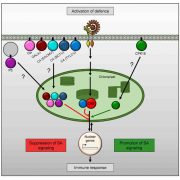
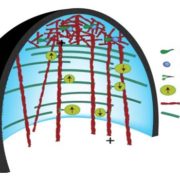
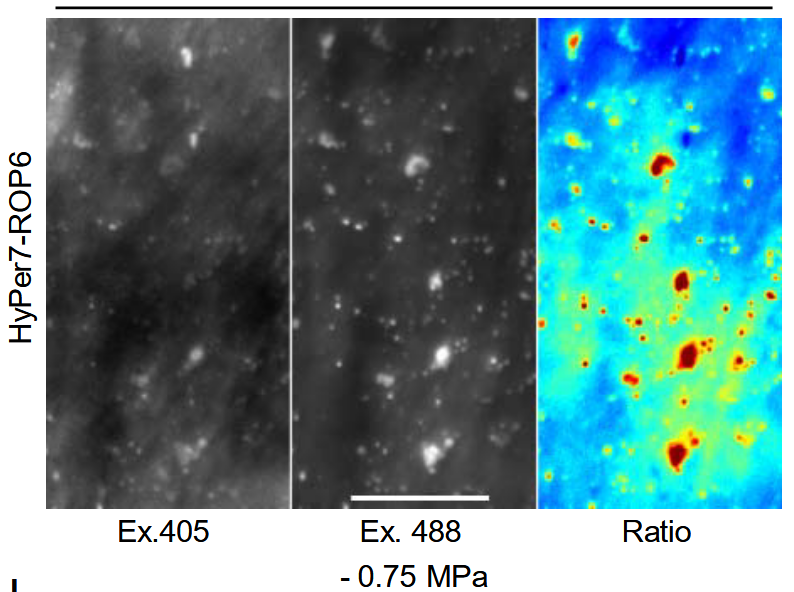 Genetic studies in Arabidopsis have identified a lot of the participants in signal transduction pathways, but often its less clear precisely where they function. As an example, although it is well known that H2O2 (hydrogen peroxide) production by RBOHs in the apoplast triggers many downstream cellular events, exactly where the signal is effective and how it reaches the cytosol is unknown. In a new study, Poitout et al. used a sensitive H2O2 reporter, HyPer7, to investigate H2O2 location in plant cells. They fused it to ROP6, a small GTPase which had previously been associated with RBOHs, and found that, upon osmotic stress, an H2O2 burst localizes with ROP6 nanodomains on the cytosolic side of the plasma membrane, demonstrating that these nanodomains can generate gradients of small diffusible molecules. Interestingly, the authors found that PIP2;7 channels (a specific class of aquaporin water channels that also transport H2O2), both co-localize with the ROP6 nanodomains and are necessary for H2O2 to effectively diffuse across the plasma membrane. It will be interesting to explore further the roles of these ROS signaling nanodomains. (Summary by Mary Williams @PlantTeaching.bsky.social) bioRxiv https://doi.org/10.64898/2026.01.19.698185