
Developmental and stress responses of single root cell mechanical properties
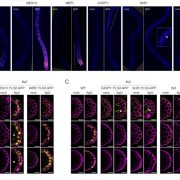
 Clearly, the mechanical properties of plant cell walls have important implications for growth and development, but they are not necessarily easy to measure, especially in intact, living tissues. Here, Alonso-Baez et al. used Brillouin microscopy and molecular rotors to characterize cell wall properties in Arabidopsis seedling roots. Brillouin microscopy determines wall stiffness and viscosity (which are not necessarily correlated) by measuring linewidth of the inelastically scattered light. Similarly, molecular rotors report on hydrodynamic porosity (mesh size) through fluorescent measurements of probe rotation. (For a great explanation of how these techniques work, check out this virtual publication from the first author https://youtu.be/uvgipGyC0mY?si=sRsx7XO3-0OeYZ6I). The authors looked at stiffness and viscosity in different tissue layers in transverse and longitudinal directions, comparing several known cell-wall mutants and responses to various treatments such as osmotic stress. They observed that the mechanical properties are quite dynamic. They vary by cell type, during developmental progression, and are affected by a wide range of mutants and environmental changes. These fascinating data demonstrate a powerful new tool with which to probe cell biology in situ and provide new insights into how cell wall properties change over time. (Summary by Mary Williams @PlantTeaching.bsky.social). Sci. Advances 10.1126/sciadv.aeb0032