
Conserved symbiont-induced actin reorganization in legumes and non-legumes
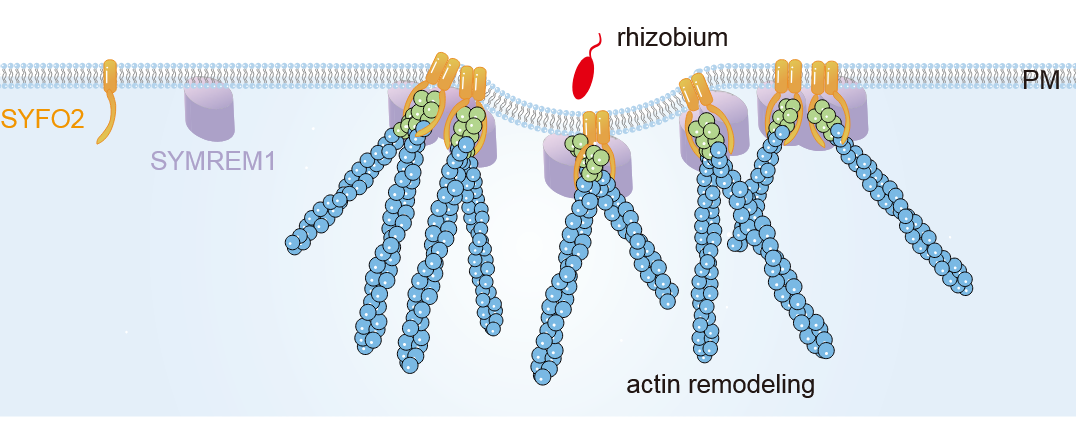 Rhizobial symbiosis requires communication and recognition between the plant host and the nitrogen-fixing bacteria. When successful, plant root hairs reorganize their membranes and form specialized infection threads through which the rhizobia enter the root and initiate nodules. In new work, Qiao et al. examined how this root hair reprogramming takes place, focusing on the reorganization of the actin cytoskeleton prior to infection thread formation. Formin proteins are conserved regulators of actin polymerization and have previously been implicated as having a role in plant-microbe interactions. In this work, the authors investigated a Medicago formin protein that is specifically activated in response to rhizobia, which was named symbiotic formin 2 (SYFO2). Wild-type root hairs exposed to rhizobia show a disassembly of actin filaments that then is reorganized within a few days and that leads to infection thread formation, but syfo2 mutants this process fails. Further investigation demonstrated that the SYFO2 protein forms punctate nanodomains that contribute to the initiation of infection threads. Interestingly, the syfo2 mutants also show a defect in symbiosis with mycorrhizal fungi, indicating a conserved function at the entry points of two distinct symbionts. In the legume Medicago, the SYFO2 gene is activated by expression of the nodulation-related transcription factor NIN. The SYFO2 gene is also present in non-legumes such as tomato that lack the NIN protein. However, when NIN is expressed heterologously in tomato it activates SYFO2 expression. The authors observe that this finding can contribute to the development of nitrogen-fixing symbiosis in non-legume plants. (Summary by Mary Williams @PlantTeaching.bsky.social). Science 10.1126/science.adx8542