
Decoding a multifunctional biosynthetic gene cluster for post-chorismate metabolism in Arabidopsis
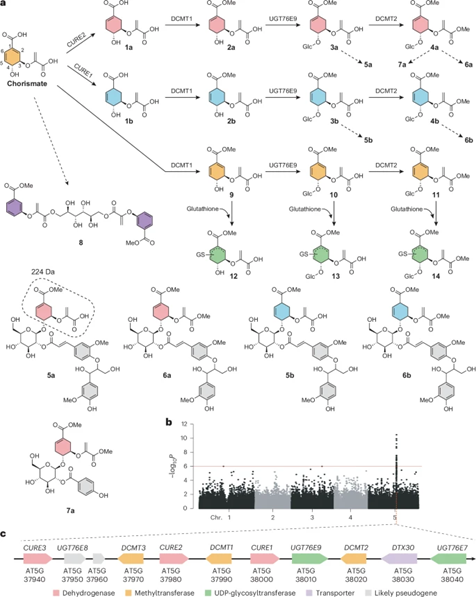 Biosynthetic gene clusters (BGCs) are groups of genes physically located in close proximity in a genomic region and can be thought of as a close-knit genomic orchestra. While these BGCs were thought to be rare in plants, unlike bacteria, Peng et al. takes the story a step ahead with the discovery of a BGC in Arabidopsis that harbors genes participating in not just one but three different chorismate biosynthetic pathways. Chorismate is a precursor to several downstream metabolites including amino acids, hormones, and vitamins. The quest for the BGC began with an uncharacterized metabolite showing up in a previous phenolic profiling study. Nuclear magnetic resonance (NMR) identified the unknown metabolite as methyl-2,5-dihydrochorismate. Genome wide association studies (GWAS) revealed a locus on chromosome 5 harboring ten enzyme-encoding genes. Genetic variations at this locus were linked to the varying abundance of a methyl-2,5-dihydrochorismate-associated compound. Six genes in the locus were strongly coexpressed with different chorismate-utilizing enzymes, confirming their role in different post-chorismate pathways. To test their functional roles, knockout and knockdown mutants were generated for metabolite profiling followed by liquid chromatography-mass spectrometry (LC-MS). These studies unravelled two parallel post-chorismate pathways producing non-aromatic compounds and a third pathway producing modified derivatives of chorismate. Candidate gene functions were ascertained using in-vitro enzymatic assays. Further evolutionary analysis showed that the cluster is present in a few closely related Brassicaceae plants, but was lost from others in the evolutionary trajectory. This work thus elegantly demonstrates the synergy of leveraging multi-omics approaches like metabolomics, genomics and transcriptomics and also looks at plant BGCs from a different lens. (Summary by Shakunthala Natarajan @shakunthalan.bsky.social) Nature Plants. 10.1038/s41477-025-02185-5