
Secondary metabolites from plants can affect nematode behavior via microbial volatile signaling cues
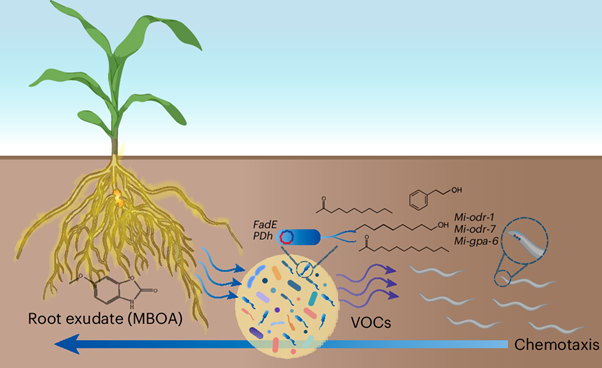 Plant parasitic nematodes such as root-knot nematodes (RKNs) are thought to use chemical cues from the plant to locate their favorable hosts. These chemical cues can code for host specificity and can drive the attraction or repulsion of nematodes. Recently, Wu et al. investigated the role of benzoxazinoids (BXs) in shaping chemoattractant cues for RKNs. BXs have been characterized as defense compounds produced by plants like wheat, rye, barley and have been demonstrated to play a role in root microbiota modulation. The authors observed a reduced RKN attraction in maize mutants of BX genes. Interestingly, this effect required the presence of soil, suggesting a role for the root microbiome. By employing bacterial profiling on BX-producing plants, the authors identified microbes either positively or negatively selected by BXs. Some of the positively selected microbes can produce volatile cues like methyl ketones and 2-phenylethanol that can function as chemoattractants for RKNs. Additionally, the authors used expression profiling and RNAi based approaches in RKNs to identify genes involved in RKN chemosensory behavior. The study provides a framework for studying plant-nematode-microbes tripartite interactions, through the lens of rhizosphere metabolites. These findings advance our knowledge about indirect effects of metabolites on ecological interactions by the plant, and reiterate the importance of context-dependency of rhizosphere interactions. (Summary by Atharv Ambekar @atharvambekar2.bsky.social) Nature Plants. 10.1038/s41477-025-02205-4