How Can Ancient Trees Remain Chemically Defended Over Centuries to Millennia?
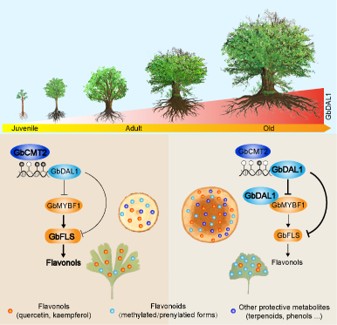 Ancient trees exhibit remarkable longevity amid changing environments over centuries to millennia. To achieve defense against biotic stresses, extensive secondary metabolism reprogramming is needed. However, the regulatory mechanisms remain unclear. In this study, using Ginkgo biloba individuals ranging from 1 to 1,070 years old, we found that ancient ginkgo trees do not simply show an age-associated decline in defensive metabolism. Instead, they undergo age-dependent epigenetic reprogramming of flavonoid biosynthesis.
Specifically, we identify GbDAL1 (DEFICIENS AGAMOUS-LIKE 1) as an age-associated transcription factor whose expression is upregulated with age. Along with aging, the promoter of GbDAL1 becomes less methylated, favouring the expression of GbDAL1. We also identify GbCMT2 (chromomethylase 2) as the major methyltransferase mediating the methylation of GbDAL1 promoter. GbDAL1 represses the expression of GbFLS (flavonol synthase) to inhibit the biosynthesis of flavanol but promotes the accumulation of methylated and prenylated flavonoids, which are more stable. These modified flavonoids preferentially accumulate in perennial tissues such as heartwood, suggesting a long-term chemical defense strategy that may contribute to the exceptional longevity and resilience of ancient ginkgo trees.
By elucidating the DNA methylation-regulated module, GbCMT2–GbDAL1–GbMYBF1/GbFLS, our study connects tree longevity, developmental age, DNA methylation, specialized metabolism, and chemical defense in an ancient tree species. Moreover, it provides a molecular example of how long-lived plants may actively adjust their defense chemistry across extreme timescales rather than simply declining with age.
Original paper: Lu J, Jiang Y, Chang B, Wang T, Ren S, Zhang X, Wang Q, Cui J, Lu Z, Liu S, et al. Age-dependent epigenetic control of flavonoid metabolism underlies chemical defenses in ancient Ginkgo biloba. Plant Cell. 2026:koag199.
Edited by: Yee-Shan Ku (LinkedIn: @Yee-Shan Ku), 2026 Plantae Editor