pH-specific coumarins recruit distinct bacterial pathways for iron acquisition in Arabidopsis
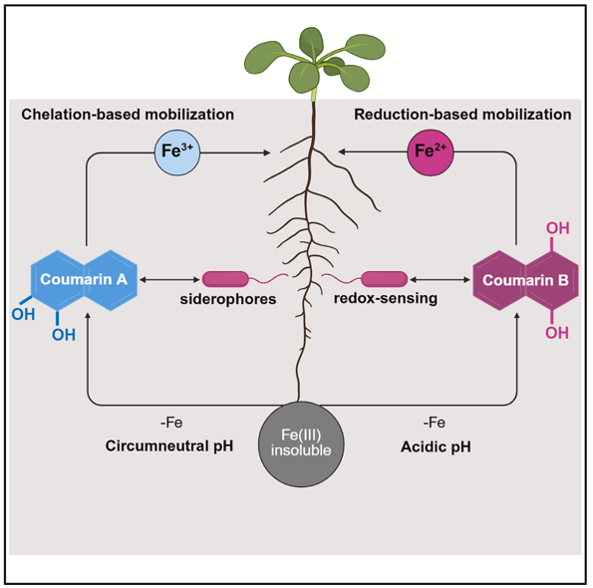 Plants need iron for growth and development, but in natural soils it occurs predominantly as insoluble Fe(III), and its availability declines with increasing pH. Under iron deficiency, Arabidopsis secretes pH-dependent coumarin chemotypes to mobilize iron. However, even with coumarin secretion, plants grown without microbes show iron deficiency, suggesting that the coumarins require the root microbiota to be fully functional. Here, Malisic and colleagues show how soil pH, root microbiota and coumarin chemotype jointly shape iron uptake. The authors tested 246 root commensals isolated from two different soils and found that most rescued iron deficiency at both acidic and circumneutral pH, regardless of soil origin. They focused on IT466, a Pseudomonas proteolytica isolate, which rescued iron deficiency through different coumarins depending on pH. At circumneutral pH, roots released more fraxetin, which acted with the bacterial siderophore pyoverdine to mobilize Fe(III) by chelation. In contrast, at acidic pH, roots enriched the coumarin sideretin, which interacted with IT466 to reduce Fe(III) to soluble Fe(II) through bacterial redox sensing pathways. IT466 did not alter the exudation of these coumarins, indicating that their pH-dependent release occurs independently of the bacteria. Together, pH-dependent coumarin release appears to be an adaptive host strategy for using the root microbiota to support iron uptake across diverse soil conditions. (Summary by Aditi Bhat @jumpy_botanist) Cell 10.1016/j.cell.2026.09.030