A bistable regulatory switch controls the timing of floral transition in Arabidopsis
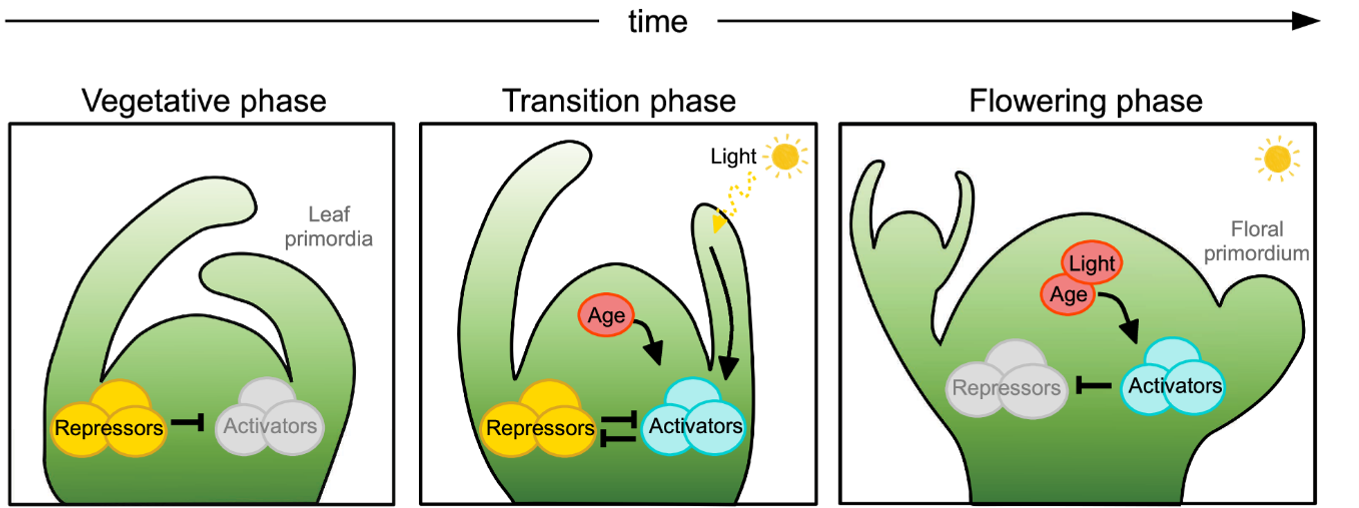 What controls the rate at which the shoot apical meristem (SAM) changes from producing leaves to producing flowers? Gabriel Rodríguez-Maroto, Kang Wang, and colleagues investigated these questions in Arabidopsis thaliana. They found that the transition to flowering depends on a balance between genes that prevent flowering and genes that promote it. APETALA2 (AP2) is a significant repressor, whereas FRUITFULL (FUL) and SUPPRESSOR OF OVEREXPRESSION OF CONSTANS1 (SOC1) activate flowering. By tracking AP2 expression, the researchers discovered that there was no consistent decline in AP2 expression levels. Rather, AP2 first dropped quickly, then more gradually, and finally even more as flowers started to appear. To understand this unusual pattern, the researchers combined genetic experiments with mathematical modelling. Their results suggested that increasing plant age and the activity of SQUAMOSA PROMOTER BINDING PROTEIN-LIKE (SPL) proteins help push the meristem towards flowering. Interestingly, the meristem can temporarily retain features of its previous vegetative state, even after the flowering process has started. This creates a delay called critical slowing down. Overall, the study shows that flowering is not simply an on-off switch. It is a gradual process influenced by the balance between flowering regulators, plant age, and the developmental history of the meristem. (Summary by Gourav Arora @gouravarora.bsky.social) Nat. Commun. 10.1038/s41467-026-76210-2