Blue light promotes root iron acquisition via a shoot CRY–HY5 signaling module in Arabidopsis
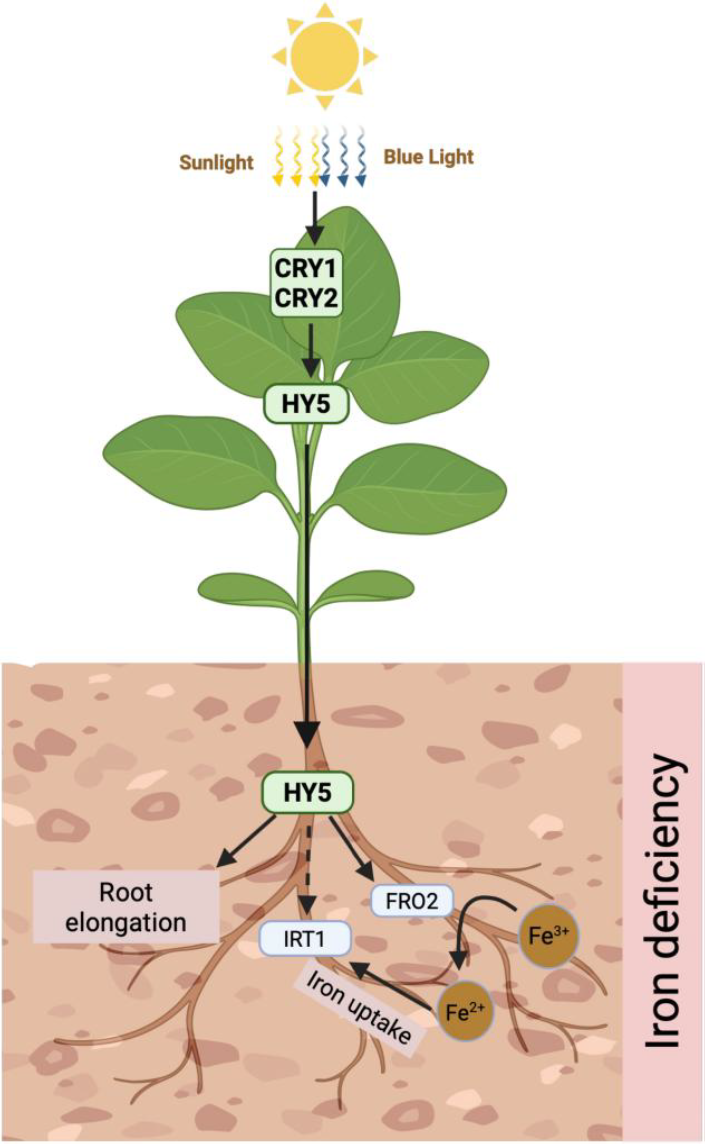 Plants constantly integrate environmental signals to coordinate their growth and development. While the role of light in regulating various plant physiological and developmental processes has been extensively studied, its contribution to fine-tuning nutrient acquisition, a root-specific process occurring belowground, remains less understood. In a recent study, Jakhar et al. investigated the interplay between light perception and iron homeostasis in Arabidopsis thaliana, providing insights into how aboveground light signals may influence belowground nutrient acquisition. They found that blue-light perception in the shoot promotes iron accumulation and root responses to iron deficiency. Interestingly, this response was wavelength-specific, as red light did not produce the same effects on root elongation under iron-deficient conditions. Genetic analysis revealed that the blue-light photoreceptors CRYPTOCHROME 1 and 2 (CRY1/CRY2) act upstream of the transcription factor ELONGATED HYPOCOTYL 5 (HY5) in this blue-light-mediated regulation. Plants lacking HY5 or both cryptochromes showed compromised root elongation under iron deficiency and reduced iron accumulation in response to blue light. These findings suggest that HY5 links light perception in aerial tissues to iron acquisition in roots, thereby providing a mechanism for coordinating environmental information with nutritional demands. Beyond establishing a link between photoreceptor signalling and iron homeostasis, this study highlights the importance of communication between different plant organs in adapting to environmental conditions. It also raises interesting possibilities for exploring how light regimes could be manipulated to improve mineral accumulation and nutritional quality in crops. (Summary by Gourav Arora, @gourav_arora_g) Plant Physiol. https://doi.org/10.1093/plphys/kiag366