
Infected parents confer nematode resistance to offspring via epigenetic modifications
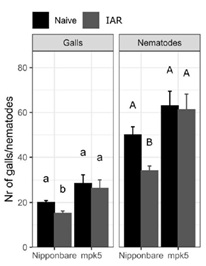 Can the stress experienced by parents enhance the resilience of their offspring? In this study, Atighi et al. investigated whether rice plants can inherit resistance against the root-knot nematode Meloidogyne graminicola from their infected parents. Their research demonstrates that offspring of nematode-infected plants exhibit significantly higher resistance to the pathogen compared to offspring of control healthy plants. This phenomenon, known as Intergenerational Acquired Resistance (IAR), is not driven by changes in the DNA sequence, but by epigenetic modifications. Focusing their molecular analyses on root tissues, the authors observed that, upon nematode attack, IAR plants display a faster and stronger transcriptional defense response compared to control plants. Comparative analysis of the epigenetic landscape reveals that the genome of IAR plants is maintained in a poised state. Specifically, this priming effect is partially linked to elevated levels of H3K4me3, a histone methylation mark associated with gene activation, on genes involved in ET and ABA signaling. A central player identified in this pathway is the kinase OsMPK5. The study reveals that OsMPK5 locus is epigenetically marked for rapid activation in primed plants. Notably, using an OsMPK5 RNAi line, the intergenerational protective effect was abolished, demonstrating the key role of this enzyme in stress memory. (Summary by Emma Olmi @olmiemma.bsky.social) J. Exp. Bot. 10.1093/jxb/erag020