
Not a Fungi after all: New clues to the identity of Prototaxites
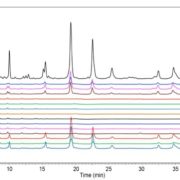
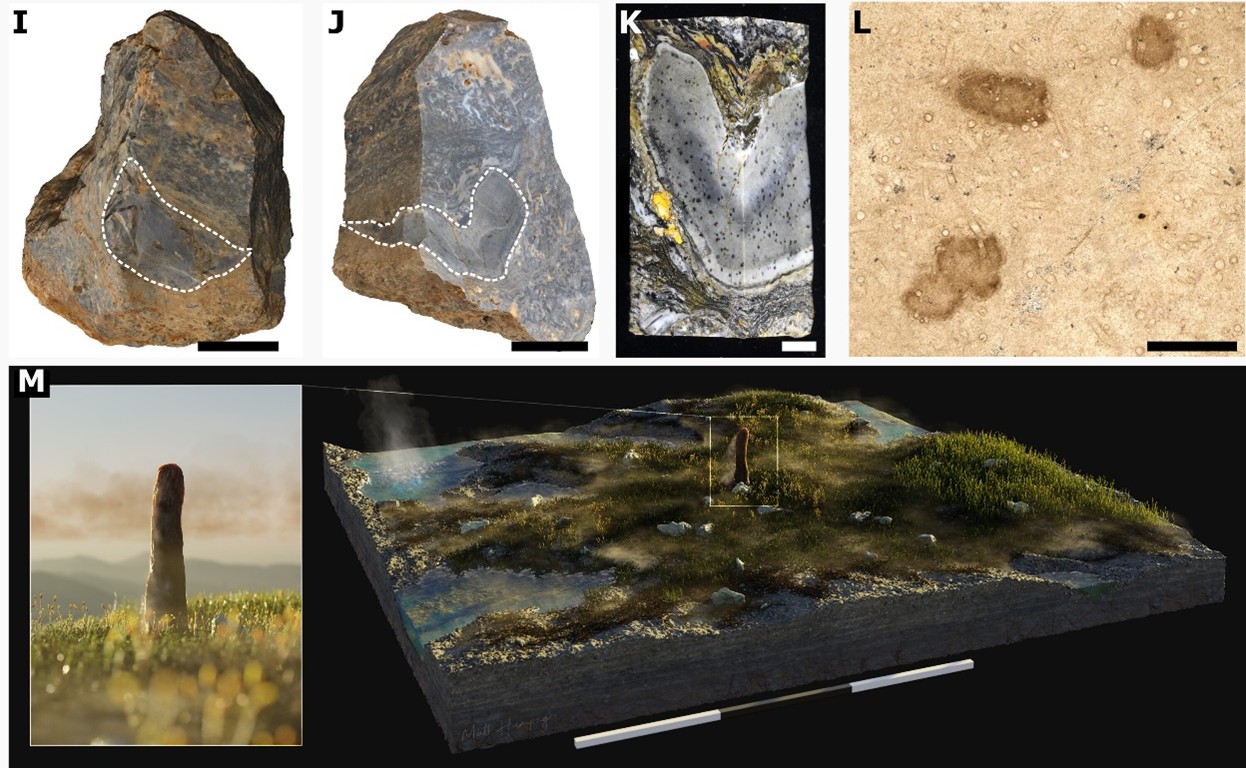 The colonization of land by plants was a crucial event in Earth’s history that fundamentally transformed our planet’s surface. Early plants were small and structurally simple, but terrestrial ecosystems also included other, non-plant organisms. Among the most striking were enigmatic organisms known as Prototaxites, which appear in the fossil record around ~ 420 million years ago and reached several meters in height, making them among the largest known terrestrial organisms of their time. Since their discovery over 165 years ago, the taxonomic identity of Prototaxites has been debated, with being a member of Fungi long considered the leading hypothesis. In a new study, Loron et al. challenge this view using exceptionally preserved Prototaxites taiti fossils from the Rhynie chert. By directly comparing P. taiti with contemporaneous fossil fungi from the same site, the authors provide rare insights into the morphology and molecular composition of this mysterious organism. Using advanced imaging approaches, including CLSM, Airyscan microscopy, and 3D reconstruction, they reveal banded arrangements of large tubes and branched “medullary spots” that are distinct from both fossil and modern fungi. Strikingly, the authors also identify annular thickenings reminiscent of plant vasculature, suggesting convergent evolution of structures involved in water transport and mechanical support. Molecular fingerprinting further shows that, unlike fungal fossils, P. taiti lacks chitin or related compounds, indicating a fundamentally different cell wall composition derived from now-extinct components. Together, these findings position Prototaxites as an independent lineage that likely played a key role in shaping early terrestrial ecosystems. (Summary by Katarina Kurtović, katarinakurtovic.bsky.social) Science Advances 10.1126/sciadv.aec6277