Directed evolution reveals pD1 mutations that boost photosynthesis under salt stress
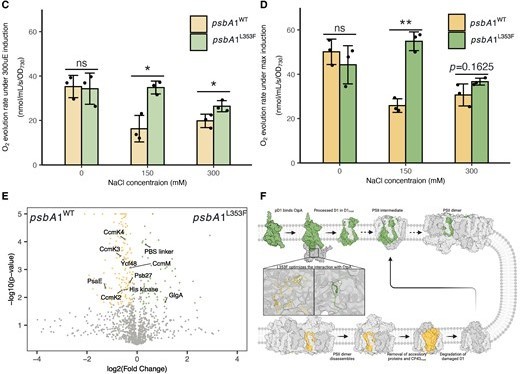 Improving photosynthesis under abiotic stress is essential for enhancing crop productivity. Here, Jiang et al. used short-term accelerated evolution in the cyanobacterium Synechococcus elongatus to uncover genetic mutations that enhance photosynthesis under salt and light stress without compromising growth. Using a hypermutator strain with conditionally suppressed DNA mismatch repair, the team conducted three rounds of directed evolution and screened over 10,000 mutants. Eight elite strains were identified with improved biomass or sucrose productivity under salt stress. Genome sequencing revealed mutations primarily in coding regions, including a consistent cluster of missense mutations at the C-terminal tail of the D1 protein (encoded by psbA1), a key component of photosystem II (PSII). Functional validation showed that L353F, I358N, and H359N mutations in the D1 precursor protein (pD1) increased salt and light stress tolerance likely by enhancing pD1 cleavage efficiency and PSII repair dynamics. These mutations improved photosynthetic capacity and stability, as confirmed by growth assays, oxygen evolution rates, pigment content, and proteomic profiling. Notably, one mutation (H359N) occurs widely across cyanobacteria and red algae, while others (L353F, I358N) are rare or novel, suggesting both conserved and previously untapped mechanisms for stress adaptation. This approach demonstrates that beneficial single-nucleotide changes can enhance both photosynthetic efficiency and stress resilience without compromising growth. The findings provide a blueprint for translational efforts to improve photosynthesis in crops by targeting D1 processing, with implications for future stress-tolerant bioengineering strategies. (Summary by Muhammad Aamir Khan @MAKNature1998) Plant Physiol. 10.1093/plphys/kiaf209