

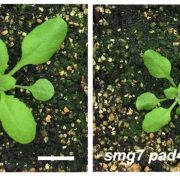
The Multifaceted Roles of UPF1 in Gene Regulation
Blog, Research, The Plant Cell, The Plant Cell: In a NutshellRaxwal et al. uncover the roles of the RNA helicase and ATPase UPF1 in regulating gene expression. The Plant Cell (2020) https://doi.org/10.1105/tpc.20.00244
By Vivek K. Raxwal and Karel Riha
CEITEC Masaryk University, Brno, Czech Republic
Background: Gene expression, i.e., the…
Dwarfed no longer: how one mutant can help the other
Blog, Research, The Plant Cell, The Plant Cell: In a NutshellWillems et al. establish that meristem organization and development rely on Anaphase Promoting Complex/Cyclosome-mediated breakdown of a cyclin.
Plant Cell https://doi.org/10.1105/tpc.20.00208
By Alex Willemsa,b and Lieven De Veyldera,b
aDepartment of Plant Biotechnology and Bioinformatics,…

Membrane tethering proteins cooperate in lipid droplet formation
Blog, Research, The Plant Cell, The Plant Cell: In a NutshellGreer et al. explore the role of SEIPIN in packaging oils into lipid droplets.
Plant Cell https://doi.org/10.1105/tpc.19.00771
By Yingqi Cai, Brookhaven National Laboratory, Department of Biology, Upton, NY 11973
Kent D. Chapman, University of North Texas, BioDiscovery Institute, Denton, TX…

Feasting While Fasting: How Autophagy Helps Maize Survive Carbon Starvation
Blog, Research, The Plant Cell, The Plant Cell: In BriefMost macro-molecular components of plant cells (e.g., proteins, lipids, and even entire organelles) are subject to an ongoing process of recycling to both rejuvenate aging structures and optimize the allocation of cellular nutrients. A major recycling route is autophagy, which occurs under normal conditions…
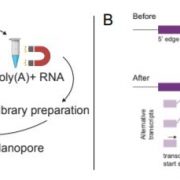
In the Transcripts: Long-read Transcriptomics Enables a Novel Type of Transposable Element Annotation in Plants
Blog, Research, The Plant Cell, The Plant Cell: In BriefTransposable Elements (TEs) are mobile genetic elements and major constituents of eukaryotic chromosomes. TEs promote genetic and epigenetic variation within genomes and are a major source of evolutionary novelty and adaptation (Lisch, 2013). In plants, TEs represent from 20% of the genomic content in…

Recognizing Plant Cell authors: Tongwen Han
The Plant Cell, The Plant Cell: Author ProfilesTongwen Han, co-first author of Rice Circadian Clock Regulates Tiller Growth and Panicle Development Through Strigolactone Signaling and Sugar Sensing
Education: M.Sc. in Sichuan Agriculture University; B.S. in Linyi University
Non-scientific Interests: basketball, chess and cooking
Brief Bio:…

Recognizing Plant Cell authors: Fang Wang
The Plant Cell, The Plant Cell: Author ProfilesFang Wang, co-first author of Rice Circadian Clock Regulates Tiller Growth and Panicle Development Through Strigolactone Signaling and Sugar Sensing
Current Position: Ph.D. Nanjing Agriculture University
Education: Ph.D. and M.Sc. at Nanjing Agriculture University; B.S. at Shandong Agriculture University
Non-scientific…

Karrikins and Strigolactone Signaling in Monocots
Blog, Research, The Plant Cell, The Plant Cell: In a NutshellZheng et al. demonstrate how monocot plants sense karrikin, a smoke-derived chemical. Plant Cell https://doi.org/10.1105/tpc.20.00123
By J Zheng, K Hong, L Zeng, S Kang and G Xiong
Background: Seedling emergence in rice depends mainly on mesocotyl elongation, which is precisely regulated by the…

Recognizing Plant Cell authors: Federico López Hernández
The Plant Cell, The Plant Cell: Author ProfilesFederico López Hernández, first author of Calcium binding by arabinogalactan polysaccharides is important for normal plant development
Current Position: Research Scientist at Tropic Biosciences
Education: B.Sc. in Biotechnology Engineering from Monterrey Institute of Technology and Higher Education,…