

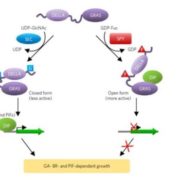
Arabidopsis O-fucosyltransferase SPINDLY activates growth repressor DELLA ($)
Plant Science Research Weekly, ResearchThe SPINDLY (SPY) gene was identified through a genetic screen; spy mutants are abnormally tall and thin, suggesting that they are overly sensitive to gibberellins. Later, the SPY gene was shown to act downstream of GIBBEERLLIN INSENSITIVE (GAI), which is a DELLA-domain containing protein. SPY was previously…
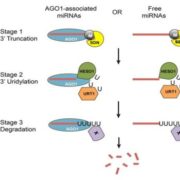
ARGONAUTE10 promotes degradation of miR165/6 through SDN1 and SDN2 exonucleases
Plant Science Research Weekly, Research0 Comments
/
ARGONAUTE10 (AGO10) was first identified through genetic studies in the 90s; loss-of-function mutants (zwille, pinhead) show premature differentiation of the shoot apical meristem. Although the mechanism has remained uncertain, AGO10 has been shown to suppress accumulation of miR165/6, which are key…
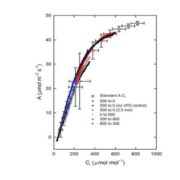
Technical Report: The rapid A–Ci response: photosynthesis in the phenomic era ($)
Plant Science Research Weekly, ResearchLarge-scale phenotyping efforts depend on large numbers of measurements, so the time taken for any one measurement has a big effect on the number of samples that can be processed. Stinziano et al. describe a breakthrough in the method used to identify the photosynthetic parameters Vc,max (maximum rate…
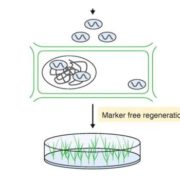
Research Highlight: Knocking out consumer concerns and regulator’s rules with CRISPR/Cas
Plant Science Research Weekly, ResearchWhen is a genome-edited plant a GMO (and subject to GMO-restrictions)? Wolter and Puchta summarize two important papers that show that CRISPR/Cas genome editing can be achieved in wheat and rice without the introduction of foreign DNA (making these plants “not GMO”), by delivering complexes of enzyme…

Review: The genomic basis of adaptation in plants ($)
Plant Science Research Weekly, ResearchEvolution starts with molecular variation and phenotypic diversity, upon which selection acts. Flood and Hancock review the approaches used to detect adaptive evolution. The top down approach starts with the phenotype and works to identify its genomic basis; examples are quantitative trait locus (QTL)…
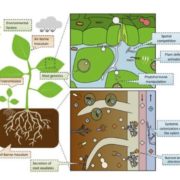
Review: Host-microbe and microbe-microbe interactions for plant breeding ($)
Plant Science Research Weekly, ResearchThe idea that the microbes on and within an organism (the microbiota) influence an organism in positive, neutral and negative ways has been a hot topic in popular science, especially the role of the gut microbiota in human health and nutrition. Plants are similarly influenced by their microbiota, as…
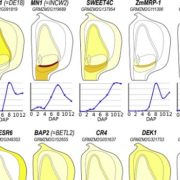
Review: Signaling in early maize kernel development
Plant Science Research Weekly, ResearchThe formation of a maize kernel requires growth coordination between embryo, endosperm, and surrounding maternal tissues. Key molecular actors in this coordination are hormones, sugars, peptides and transcription factors. Doll et al. review recent advances in our understanding of maize kernel development,…
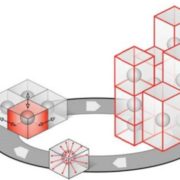
Review: Synthetic botany
Plant Science Research Weekly, ResearchAs photosynthetic autotrophs, plants have the potential to convert sunlight into a vast array of useful products: to act as little green metabolic factories. Of course, they already provide us with everything from carbohydrates and vitamins to stimulants and medicinal compounds, but with a few small…

Review: Modifying bananas: From transgenics to organics?
Plant Science Research Weekly, ResearchDid you know that bananas are: one of the top ten world food crops, the world’s most popular fruit, eaten in nearly every country, and an important food security crop in regions where they are grown? Did you also know that most bananas are triploid and usually sterile, making conventional breeding…