


Special Issue: Plant evolutionary developmental biology (Plant Evo-Devo) ($)
Blog, Plant Science Research Weekly, Research, Research BlogThis issue is rooted in the 37th New Phytologist Symposium on ‘Plant developmental evolution’, 2016, that gathered researchers working on the developing field of plant evo-devo. The issue is a wonderful compendium of work presented during the symposium and the contribution of other researchers working…
What We're Reading: October 6th
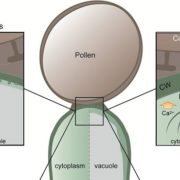
Blog, Research, Research BlogSpecial Issue: Plant evolutionary developmental biology (Plant Evo-Devo) ($)
This issue is rooted in the 37th New Phytologist Symposium on ‘Plant developmental evolution’, 2016, that gathered researchers working on the developing field of plant evo-devo. The issue is a wonderful compendium of…
SIEVE ELEMENT-LINING CHAPERONE 1 restricts aphid feeding on Arabidopsis during heat stress ($)
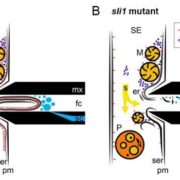
Blog, Plant Science Research Weekly, Research, Research BlogAphids are major pests that damage plants by sucking out phloem sap and as by acting as vectors in transmission of more than 300 different viruses. Kloth et al. used a high-throughput method involving video-tracking of aphid behavior on leaf discs to score 350 Arabidopsis accessions for aphid resistance.…

Write a Plant Science Haiku: And the winner is...
Blog, Education, Research, Research BlogThe September Plantae competition asked plant scientists to write and submit haiku about plant science. With nearly 100 submissions, our judges struggled to make their decision. Most of the submissions embodied the spirit of the haiku form, many were lovely, nearly all expressed the author's fascination…

Plant Cell EIC Sabeeha Merchant meets with Chinese plant scientists
Blog, Research, Research Blog, The Plant Cell, The Plant Cell: NewsSabeeha Merchant, Editor-in-Chief of The Plant Cell, recently spent a week in China meeting with Chinese scientists at SIPPE (Shanghai Institute of Plant Physiology and Ecology) and FAFU (Fujian Agriculturlal and Forstry University) to learn about their research. She emphasized the power of technology…
BLADE-ON-PETIOLE proteins act in an E3 ubiquitin ligase complex to regulate PHYTOCHROME INTERACTING FACTOR 4 abundance
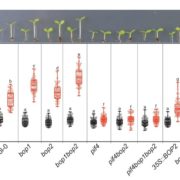
Blog, Plant Science Research Weekly, Research, Research BlogPlants need light not only for photosynthesis but also for light dependent development (called photomorphogensis). PHYTOCHROME INTERACTING FACTOR (PIF) proteins accumulate in dark to negatively regulate photomorphogensis. PIFs get degraded via 26S proteasome pathway in response to light e.g., PIF4 is…

Functional identification of MdPIF1 as a Phytochrome Interacting Factor in apple ($)
Blog, Plant Science Research Weekly, Research, Research BlogPIF1 is a well-studied negative regulator of phytochrome-mediated photomorphogenesis in Arabidopsis. Zhou et al. cloned the PIF1 cDNA from apple (Malus domestica) and characterized the gene itself. Interestingly, the bHLH and active Phytochrome B binding (APB) motif is conserved in MdPIF1 and a complementation…
What We're Reading this week: September 29th
Blog, Research, Research BlogThis week’s edition of What We’re Reading is guest edited by Nidhi Sharma. Nidhi is a researcher in Dominique Bergmann's lab at Stanford University. She graduated from The University of Texas at Austin and did post-doctoral work with Dr. Kathy Barton at Carnegie Institution of Science. Other than…

Review: Roles for IBA-derived auxin in plant development ($)
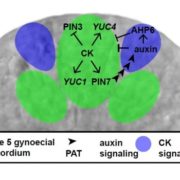
Blog, Plant Science Research Weekly, Research, Research BlogAuxin biosynthesis is a two-step process: First, tryptophan is converted to indole-3-pyruvic acid (IPyA) through the activity of the TAA1 (TRYPTOPHAN AMINOTRANSFERASE OF ARABIDOPSIS1) family of aminotransferase enzymes. IPyA is finally converted to IAA (Indole Acetic Acid) by YUCCA family of flavin…