

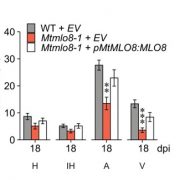
Mildew Locus O facilitates colonization by arbuscular mycorrhizal fungi in angiosperms (New Phytol.)
Plant Science Research WeeklyIn plants, disease resistance genes typically act in a dominant way – the presence of a resistance allele, even a single copy, is enough to confer resistance. The barley gene Mildew Resistance Locus O (MLO1) is different, as it acts in a recessive way; loss-of-function mlo1 plants are resistant to…
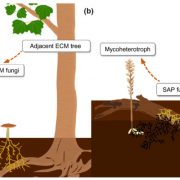
Some mycoheterotrophic orchids depend on carbon from deadwood: novel evidence from a radiocarbon approach (New Phytol.)
Plant Science Research WeeklyA mycoheterotrophic ("fungal-other-eating") plant takes carbon nutrients from a fungus, but as fungi are not themselves photosynthetic, the (ectomycorrhizal) fungus must get its carbon from somewhere, usually a plant. Thus the typical flow of carbon goes from autotrophic photosynthesizing plant to fungus…
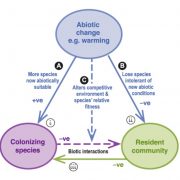
Community diversity outweighs effect of warming on plant colonization ($) (Global Change Biol.)
Plant Science Research WeeklySeveral studies have addressed growing concerns regarding increases in exotic plant colonization of communities in response to a warming climate. However, both abiotic (e.g., warming climate) and biotic (e.g., changes in community diversity) shifts can be simultaneous results of warming and both can…
Plant Science Research Weekly: March 7
Blog, WWR Full PostReview: How mycorrhizal associations drive plant population and community biology ($)
Great strides have been made in discovering the molecular players that allow plants and mycorrhizal fungi to establish their symbiosis. Here, Tedersoo et al. look beyond the single plant and address how these associations…

Viral proteins activate autophagy
Research, The Plant Cell, The Plant Cell: In a NutshellIsmayil et al. identify a virus that activates autophagy and reveal the underlying mechanism.
Plant Cell https://doi.org/10.1105/tpc.19.00759
By Asigul Ismayil, MOE Key Laboratory of Bioinformatics, Center for Plant Biology, Tsinghua-Peking Joint Center for Life Sciences, School of Life Sciences,…

Pol IV Function is Differentially Essential within the Brassicaceae
Research, The Plant Cell, The Plant Cell: In BriefAt least five RNA polymerases (Pol I to Pol V) are known to exist in plant cells. Pol IV produces short transcripts that are converted into double-stranded RNAs by RNA-dependent RNA polymerase 2 (RDR2) and processed into 24-nucleotide (nt) small interfering RNAs (siRNAs) by DICER-LIKE 3 (DCL3). These…

Announcing our 2020 Class of Plantae Fellows
Blog
As part of our ongoing commitment to creating a vibrant and engaging community for plant scientists, we launched the Plantae Fellow Program in 2016. With over 80 applicants from all over the world, we are proud to announce the people accepted into this year’s class.
The role of the Fellows is…

Attacking the front and the rear – the elaborate control of reactive oxygen species production
Research, The Plant Cell, The Plant Cell: In a NutshellKimura et al. reveal how phosphorylation of a key enzyme activates reactive oxygen species production. Plant Cell https://doi.org/10.1105/tpc.19.00525
Sachie Kimuraa,b, Michael Wrzaczeka
aOrganismal and Evolutionary Biology Research Programme, Viikki Plant Science Centre, Faculty of Biological…

When to Sleep? CHT7 is Critical for Nutrient-dependent Quiescence in Chlamydomonas
Research, The Plant Cell, The Plant Cell: In BriefTo survive nutrient scarcity, unicellular organisms establish a reversible quiescent state in which cells cease growth and division and switch metabolism to an energy-conserving mode. When nutrients become available again, cells exit from quiescence and resume growth and division. The mechanistic details…