
Unraveling soybean evolution: Insights from 8,105 genomes
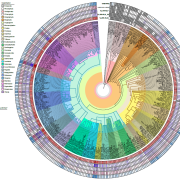
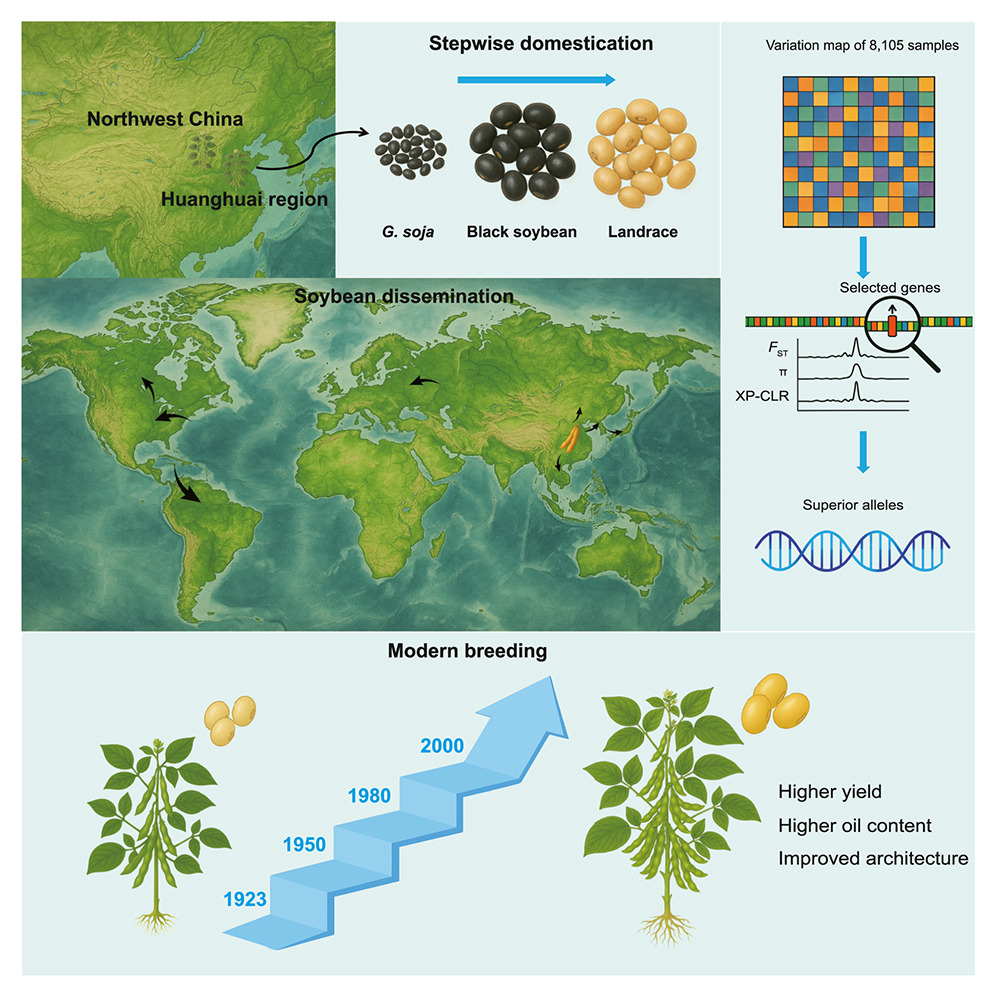 Soybean is one of the most important cash crops for global food and feed, valued for its high-quality plant oil and protein. Centuries of domestication and breeding have narrowed its genetic diversity, leaving current cultivars vulnerable to climate change. To address this, Zhu and colleagues generated a comprehensive genomic resource by analyzing 8,105 soybean accessions, including wild relatives, landraces, and domesticated cultivars. They identified over 48 million SNPs and more than 10 million indels, offering an unprecedented overview of genomic variation across the species. All haplotype and QTL data have been made publicly accessible through the SoyOmics platform (https://ngdc.cncb.ac.cn/soyomics/breedingtips), providing a powerful toolkit for basic and applied research. Using this dataset, the authors traced soybean’s evolutionary trajectory and domestication origin. Phylogenomic analyses highlighted the unique status of black soybean, revealing it as a transitional intermediate in the shift from wild to fully domesticated forms and in the notable transition from black to yellow seed coat. As a showcase of the dataset’s power, the study also resolved a long-standing question in pod-shattering biology. Although GmSHAT1-5 and GmNST1A were known regulators, genetic evidence had been lacking. The team discovered clear haplotype differentiation at GmNST1A: wild and black soybean carry a full-length Hap1 allele, whereas landraces and cultivars possess a premature-stop Hap2 allele. Despite unchanged nuclear localization, Hap1 exhibited stronger activation of the GmSHAT1-5 promoter, accounting for differential pod shattering during domestication. Looking ahead, this expansive genomic resource opens new frontiers for mining gene functions, understanding adaptive evolution, and designing next-generation breeding strategies to build more resilient soybean varieties. (Summary by Ching Chan @ntnuchanlab) Cell 10.1016/j.cell.2025.09.007