

Review: Signaling in early maize kernel development
Plant Science Research Weekly, Research0 Comments
/
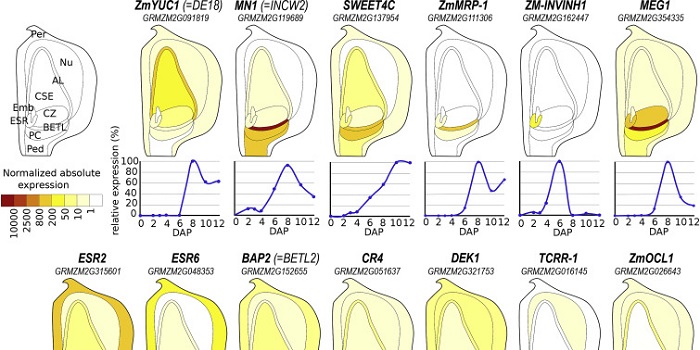
The formation of a maize kernel requires growth coordination between embryo, endosperm, and surrounding maternal tissues. Key molecular actors in this coordination are hormones, sugars, peptides and transcription factors. Doll et al. review recent advances in our understanding of maize kernel development,…
Welwitschia mirabilis sheds light on ancestral mechanisms prefiguring floral development ($)
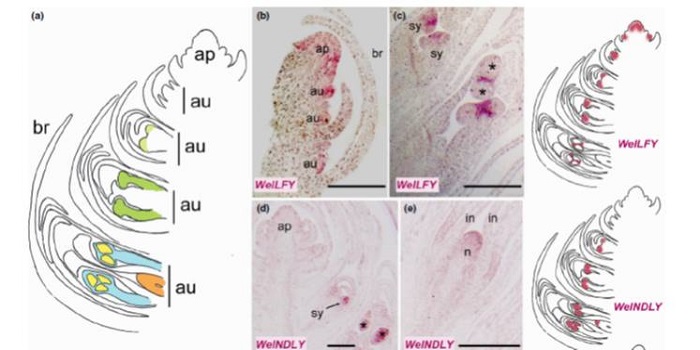
Plant Science Research Weekly, Research, Research BlogIn order to look at the origins of flowers, Moyroud et al. looked at reproductive controls in the gymnosperm Welwitschia mirabilis, which, as the authors say, is a good model because, “Although the plant body is famously bizarre, the reproductive structures are generalized.” Furthermore, its male…
Structure of SHR–SCR heterodimer bound to BIRD/IDD transcriptional factor JKD
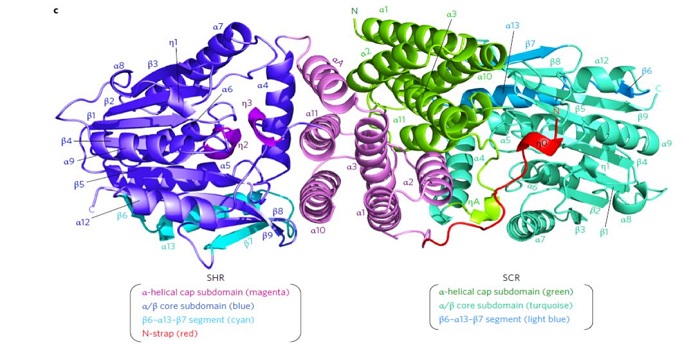
Plant Science Research Weekly, Research, Research BlogStructural biology provides a key link between genotype and phenotype. Hirano et al. probe the structure of a heterodimer of plant-specific GRAS family transcriptional regulators [SHORT-ROOT (SHR) and SCARECROW (SCR)] as bound to the transcription factor JACKDAW (JKD). The GRAS family proteins (encoded…
Molecular signals for regeneration ($)
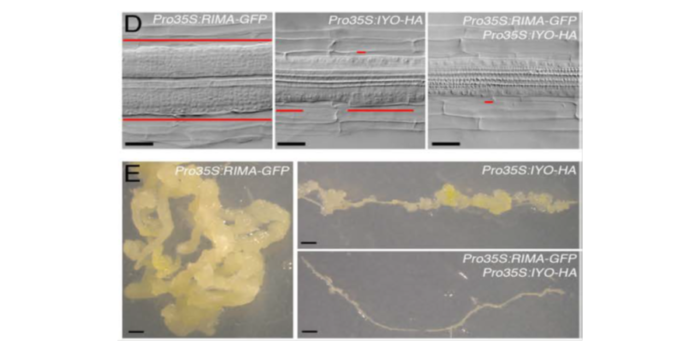
Plant Science Research Weekly, ResearchEvery gardener knows that pulling off a shoot is not sufficient to kill a plant. Plants are able to reprogram cells in order to regenerate missing tissues. Pulling off a shoot removes photosynthetic tissues, but the root responds by activating chloroplasts to take over this role. Kobayashi et al. (Plant…
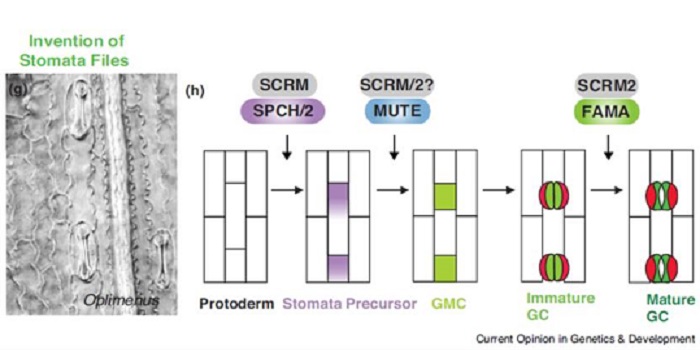
Review: Stomatal development in time: the past and the future ($)
Plant Science Research Weekly, ResearchStomata, epidermal pores for gas exchange, first appeared about 400 million years ago. Since then, there has been functional and structural diversification. Qu et al. synthesize the developmental genetics underpinning diverse stomata, spanning from bryophytes through monocots and the astomatous (without…
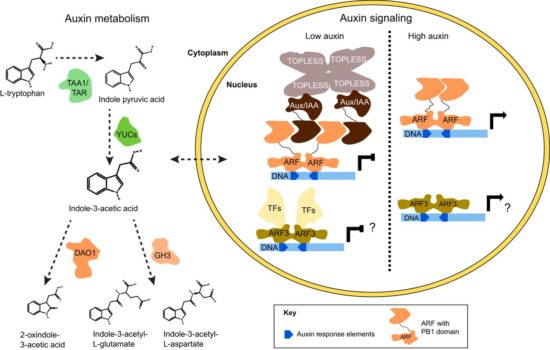
Meeting Review: Auxin 2016 ($)
Plant Science Research Weekly, ResearchVernoux and Robert discuss research presented at the Auxin 2016 meeting, held in October 2016 on the island of Hainan, China. The result is a nice review of very current research, spanning auxin metabolism and signaling, the role of auxin in development, interactions between auxin and other signals,…
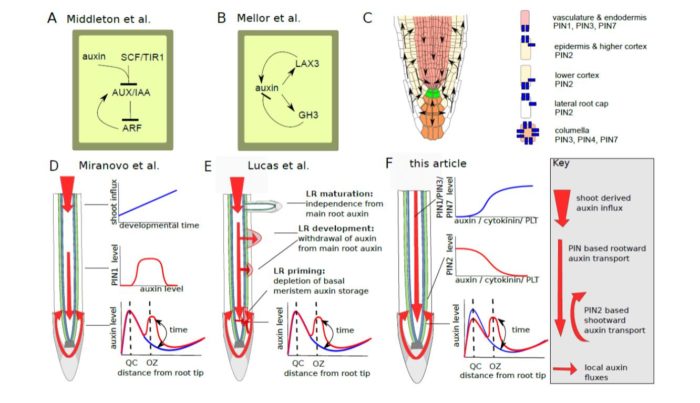
Perspective: Periodic lateral root priming: What makes it tick
Plant Science Research Weekly, ResearchThe very earliest step in lateral root formation is “priming”, a still-elusive process that establishes a subset of cells as competent to form lateral roots. In this Perspective, ten Tusscher and Laskowski review evidence for priming, which involves oscillations of auxin level or responsiveness…

Generation of shape complexity through tissue conflict resolution
Plant Science Research Weekly, ResearchIt’s easy to visualize how a sheet of cells grows, but how does a sheet of cells form a complex, three-dimensional structure? Rebocho et al. describe how differential growth rates between cell layers and across the growing surface can produce a variety of complex shapes. As a model for shape complexity,…
Andrea Eveland Teases Apart Gene Networks in Crop Plants
Blog, Careers, Profiles of Plant ScientistsThe Scientist (Feb 1 2017) profiles Andrea Eveland, Principle Investigator at the Danforth Center.
Read more here Andrea Eveland Teases Apart Gene Networks in Crop Plants
Her lab webpage https://www.danforthcenter.org/scientists-research/principal-investigators/Andrea-Eveland