Senescence to nutrient cycling: Top-down effects of climate change
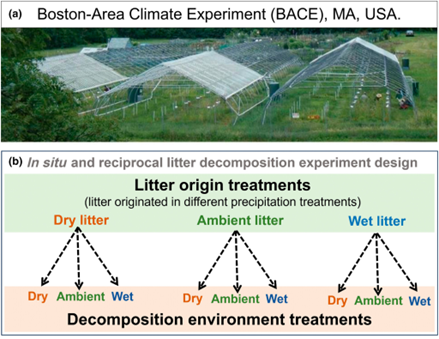 Precipitation plays an important role in shaping leaf tissue composition, and as climate change progresses, we’ll likely see dramatic shifts in precipitation regimes. Changes in leaf tissue composition due to increased rainfall or drought may have cascading effects on soil microbe communities and ultimately nutrient cycling during senescence. In this long term study, Zhang et al. explored the direct and indirect effects of climate change on leaf chemistry and soil nutrients. The authors grew Quercus rubra and Quercus velutina under dry, ambient, or wet conditions. They followed these treatments by examining the rate of decomposition of these different leaves under dry, ambient, or wet conditions. As expected, leaf litter from drought treatments contained higher concentrations of lignin and alkyl compounds (e.g., cutin, waxes, and lipids), which are synthesized in response to drought stress. Decomposition rates were variable, but they did observe faster decay with dry-grown leaves of Q. rubra under dry decomposition conditions, highlighting that leaf decay may be species specific. Lastly, they found downstream effects of dry decay conditions, with increased ergosterol in soil, which is an indicator of elevated fungal growth. While many studies focus on the effects of climate on plant structures or the soil microbiome, this paper provides a novel insight into the top-down effects of climate change in an ecosystem. (Summary by Xavier Ozowara [email protected]). New Phytol. 10.1111/nph.70449