
A wheat immune receptor that breaks the mold: The octameric WAI3 resistosome
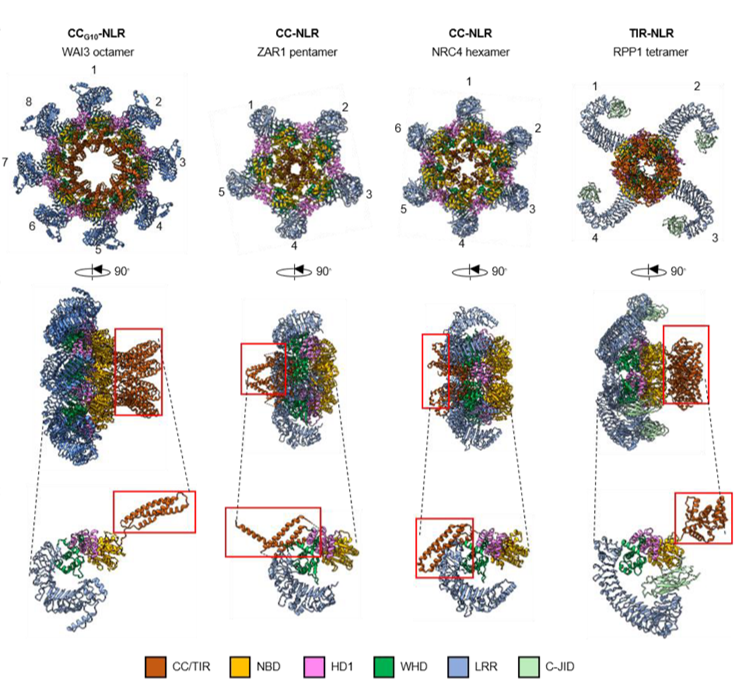 Plants may not have white blood cells, but they are far from defenseless. Instead, they rely on specialized immune receptors called NLRs (nucleotide-binding leucine-rich repeat receptors) to recognize intracellular invaders and trigger strong defense responses. These receptors are molecular shape-shifters, assembling into large multi-protein complexes known as resistosomes. For example, the ZAR1 resistosome forms a pentamer, NRC4 assembles as a hexamer, and RPP1 as a tetramer. In a recent study, Guo and colleagues uncovered an unusual case in wheat through a forward genetic screen. They identified an EMS mutant in the gene Wheat Autoimmunity 3 (WAI3), which shows constant activation of plant immunity. WAI3 belongs to a unique sub-clade of G10-type coiled-coil NLRs, distinct from other CC-NLRs. When expressed in Nicotiana benthamiana, a truncated (inactivated) version of WAI3 unexpectedly formed an octameric resistosome—the largest oligomeric assembly reported for plant NLRs so far. Intriguingly, WAI3 lacks the EDVID domain, a structural element that stabilizes domain interactions in other resistosomes. This absence results in a distinct domain arrangement and LRR topology. While WAI3 still exhibits calcium channel properties like ZAR1, the significance of its unusual architecture remains an exciting open question for future research. (Summary by Ching Chan @ntnuchanlab) bioRxiv 10.1101/2025.08.26.672026