Review: Plants calcium signaling is both conserved and plant-specific
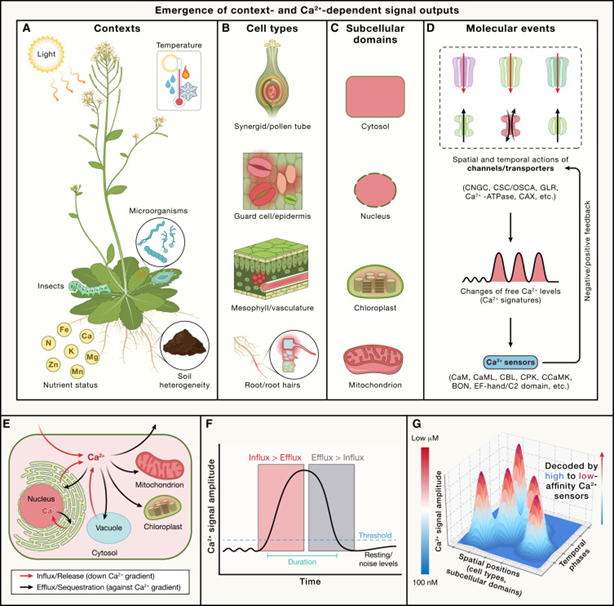 Although calcium ions are universal second messengers, plants employ both conserved and unique strategies to decode Ca²⁺ signals. In a new review in Cell, Sheng Luan reviews the molecular tools used to study calcium signaling in plants and the mechanisms that govern this process. Like other cells, plant cells maintain low internal Ca²⁺ levels (about 100 nM), even though the extracellular concentration is much higher, allowing them to generate signals quickly. When triggered, specific Ca²⁺-permeable channels, such as cyclic nucleotide-gated channels, and glutamate receptor-like proteins (GLRs) open to admit calcium ions, generating distinct “Ca²⁺ signatures” based on the strength, frequency, and location of influx. Efflux transporters such as autoinhibited Ca²⁺-ATPases and cation/H⁺ exchangers end these signals, often regulated by Ca²⁺ sensors. Plants use a wide range of sensors, including calmodulin (CaM), many CaM-like proteins, calcium-dependent protein kinases, and the plant-specific calcineurin B-like protein–CBL-interacting protein kinase network. The review explores the conserved nature of calcium signaling in eukaryotic cells but also covers Ca²⁺ signaling in root growth, pollen tube guidance, responses to stress, nitrate sensing, immunity (where NLR resistosomes act as Ca²⁺ channels), and wounding responses through GLR3.3 and GLR3.6 channels, which are similar to nerve signals in animals. Luan ends by posing ten open questions, such as how to identify thermosensitive channels and how sustained Ca²⁺ increases lead to cell death. Together, this comprehensive review highlights how plants use the universal language of Ca²⁺ into a versatile signaling system tailored to their sessile way of life and it identifies key challenges for future research. (Summary by Jahed Ahmed) Cell 10.1016/j.cell.2025.12.027