
Review: How WOXs regulate regeneration in land plants
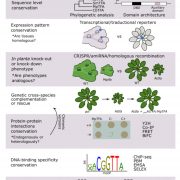
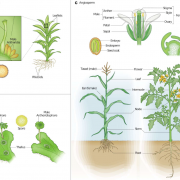
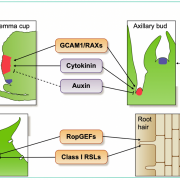
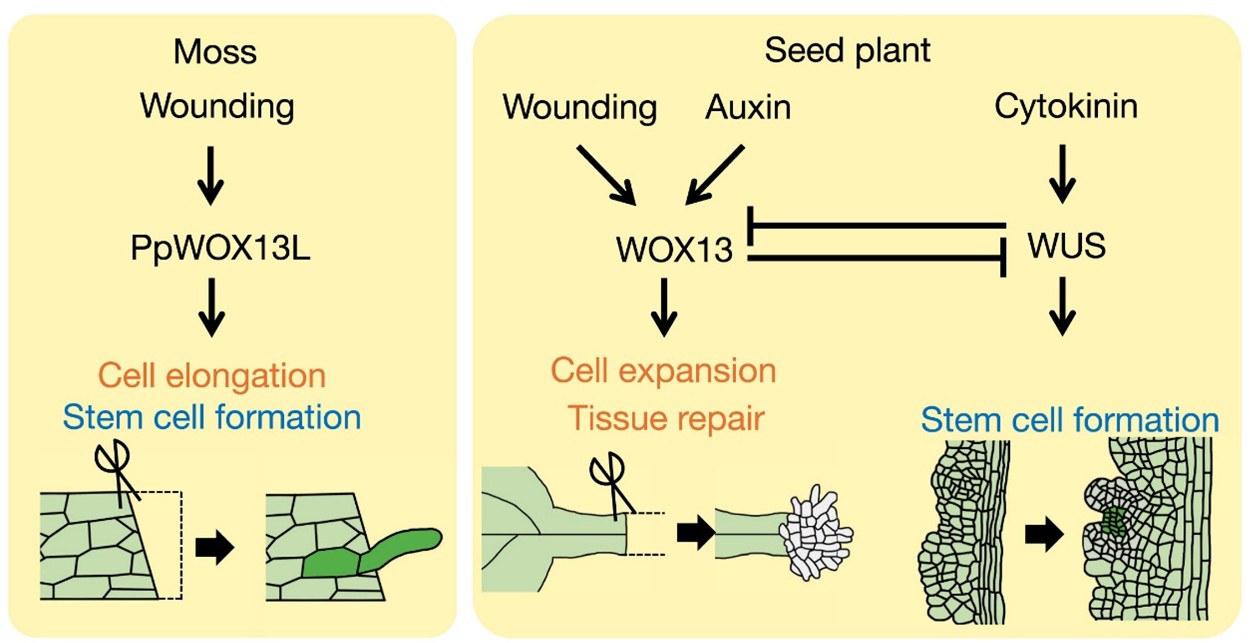 Plants cannot escape a bite from herbivore or being cut by a lawn mower, but they can regrow new leaves or even entire stems after damage. From simple mosses to giant sequoia trees, the process of building a new organ after wounding may be more similar than we previously thought. Key players in this process are the WUSCHEL-RELATED HOMEOBOX (WOX) family of transcription factors. In a recent review, Doll and colleagues discuss both shared and distinct roles of the WOX family in cellular reprogramming and organ regeneration across land plant lineages. WOXs can be divided into ancient (Type 1, T1), intermediate (Type 2, T2), and modern clades (Type 3, T3). Recent phylogenetic studies suggest, however, that the common ancestor of all land plants already contained both ancient and intermediate/modern superclades. Increasing interest in an evo-devo perspective has led to the analysis of WOX function in previously understudied lineages. In Physcomitrium patens, for example, the PpWOX13L gene is involved in reprogramming leaf cells into protonema stem cells. In Selaginella, SmWOX13a may drive regeneration of root tips. However, in contrast to its role in P. patens, WOX13 negatively affects stem cell establishment in Arabidopsis tissue culture, likely due to differences in cell wall regulation and loosening. The authors also emphasize that our understanding of plant regeneration is still based on a limited number of model species, and broader studies across bryophytes, ferns, and lycophytes are needed to fully understand the evolution of regeneration in land plants. (Summary by Katarina Kurtović, @katarinakurtovic.bsky.social) Curr. Opin. Plant Biol. 10.1016/j.pbi.2026.102882