
Signals in the air and soil: the hidden communication circuit that shapes plant resilience
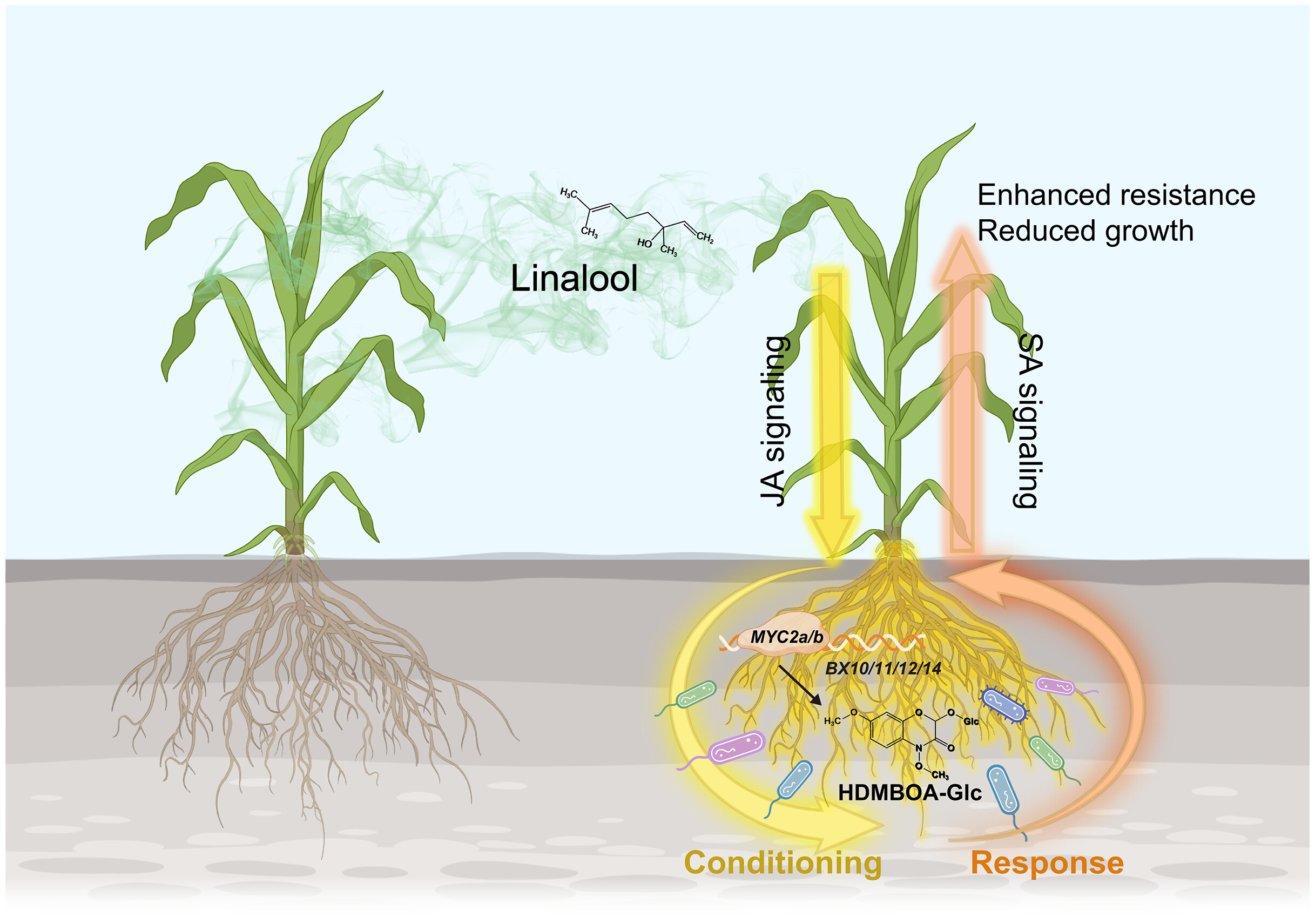 When plants grow shoulder to shoulder in crowded fields, they don’t just compete for space and sunlight—they also “talk” to one another. This underground and airborne chatter, carried by leaf volatiles and root exudates, helps plants sense nearby neighbors and prepare for threats. But how exactly does this communication unfold? Guo and colleagues set out to untangle this mystery using maize. They first grew plants at different densities, each in its own pot, then used the conditioned soil to raise new plants. Remarkably, seedlings grown in soil from high-density environments grew smaller but were far tougher against herbivores, fungi, and viruses. Something in the soil was clearly transmitting a memory of crowding. Digging deeper, the team traced the signal back to a leaf volatile: linalool. This compound activates jasmonate signaling in neighboring plants, triggering the roots to release benzoxazinoids. These chemicals reshape the rhizosphere microbiome, which in turn bolsters plant immunity – at the cost of growth. The study uncovers a remarkable feedback circuit, showing how maize reprograms itself in crowded settings by channeling energy from growth into defense. (Summary by Ching Chan @ntnuchanlab) Science 10.1126/science.adv6675