
Rice viruses hijack plant volatiles to shield insect vectors from natural enemies
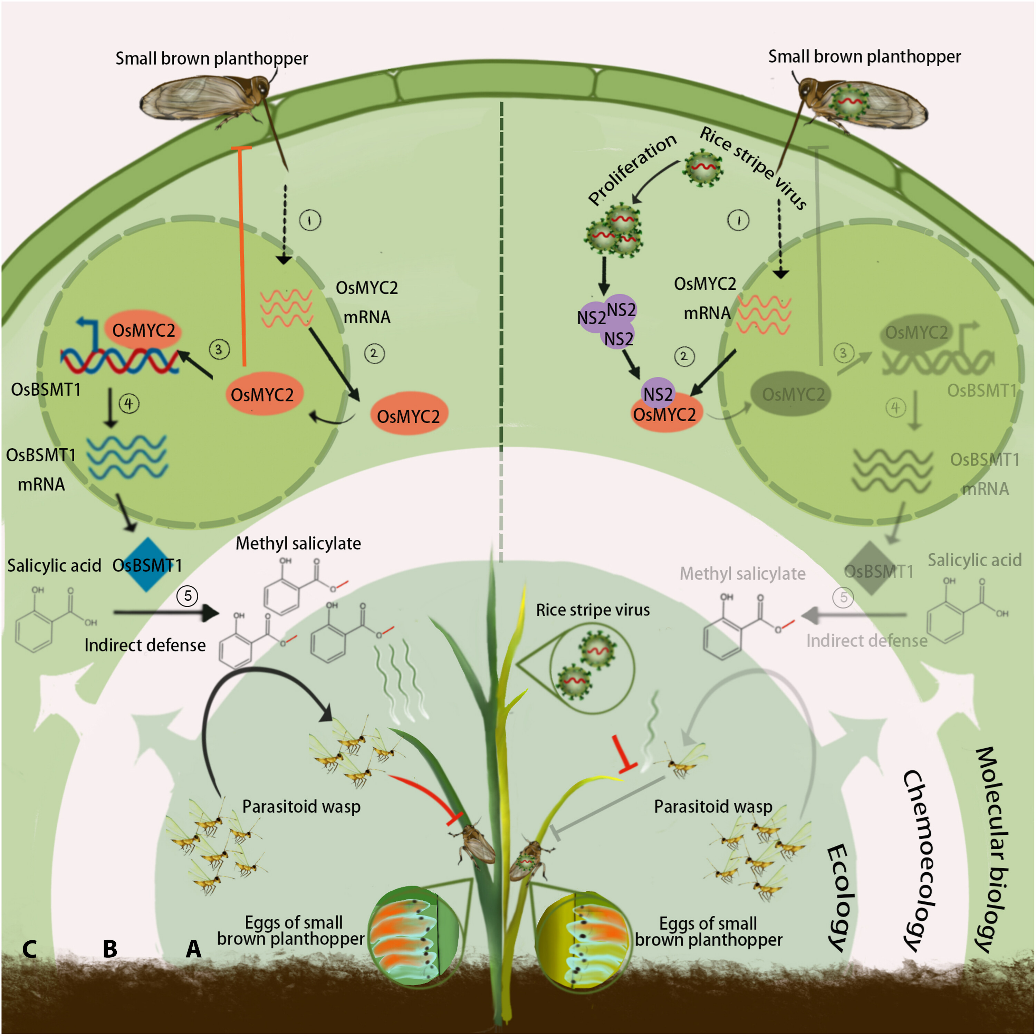 Vector-borne viruses such as rice stripe virus (RSV) are transmitted from plant to plant by insects such as planthoppers. Plants under attack often emit volatile compounds such as methyl salicylate (MeSA) that attract parasitoid wasps that destroy the eggs of the virus-transmitting insects. In a recent study, Liu and colleagues found that rice viruses decrease the plant’s release of MeSA, leading to higher insect abundance that allows the virus to spread more easily. The researchers showed that when insects feed on rice, they trigger the transcription factor OsMYC2, which in turn activates OsBSMT1, the enzyme that produces MeSA. RSV blocks this process by expressing its NS2 protein, which binds to OsMYC2 and keeps it in the cytoplasm, preventing OsBSMT1 activation. This strategy was seen in several rice-virus systems. Notably, in field trials where virus-infected plants were grown next to sustained-release spheres emitting MeSA, the viral-transmitting insect levels decreased and parasitism rates were restored to normal levels. This suggests that using MeSA could be a sustainable way to manage vector-borne diseases in rice. (Summary by Jahed Ahmed) Science Advances 10.1126/sciadv.aeb5215