
Promoting Science Communication Through Community Engagement
Plant science has always been at the heart of human progress as it involves feeding our communities, sustaining our ecosystem, and offering solutions to global challenges like climate change and food insecurity. Yet, its impact may go unnoticed beyond the lab or academic circles. Hence, scientists need to engage in science communication and to develop their science communication skills, a skill that is not automatically acquired just because one is a plant scientist (Plantae blog, 2024). This is an additional hurdle that makes being a scientist in the 21st century more challenging. In an age where misinformation and scientific mistrust are widespread, the role of plant scientists as communicators has never been more crucial. Clear, inclusive, and community-oriented communication helps ensure that plant science is not just understood but trusted and valued by the society it serves.
Outreach activities offer a powerful way to bridge this gap. However, outreach is just about sharing science with communities (one-way). On the other hand, community engagement is about doing science with communities, as it represents a deeper, more participatory level of interaction where the community becomes a partner rather than a recipient only, thereby transforming big science lab discoveries into simple out-of-lab conversations that inspire action, policy, and even the next generation of scientists (two-way).
But how do we, as plant scientists, translate the complexity of genetics, multi-omics, and ecology into stories that resonate with everyday life? What does effective engagement look like across different regions of the world, and how can scientists find creative ways to share their work beyond journal articles and conferences? This blog seeks to explore these questions through the lens of outreach activities led by plant scientists across four continents- Europe, North America, Africa, and Australia. By sharing these community-driven projects and drawing inspiration from platforms like the Plantae webinars, we uncover the many ways that plant science can be brought to life in local and global communities, even in the “little” ways.
Europe: Connecting Science with Everyday Life
Across Europe, science communication has become a growing movement, with universities, research consortia, and grassroots initiatives recognizing its value in bridging the gap between research and society. Events such as Soapbox Science have gained traction in major European cities, reshaping public perceptions of science and scientists by taking research out of the lab and into the streets (Boakes et al., 2021).
In 2022, CEPLAS doctoral researcher Mary Ngigi joined this movement when she took to the soapbox at the Rheinland event to speak about iron malnutrition, a pressing global health issue that affects both developed and developing regions (WHO, 2021). Rather than relying on technical data or laboratory jargon, Mary used relatable metaphors and accessible language to illustrate the impact of plant nutrition on human health.
The impact of this approach was immediate. Shoppers and passersby stopped to listen, ask questions, and reflect on their own dietary choices. One particularly memorable moment came when a woman approached after the session to share her struggles with iron deficiency. The woman explained that the talk had helped her to understand how her diet might influence her condition. Encounters like this underscore the popular quote that says “people don’t care about what we know until they know that we care,” and in this context, when our science connects directly to their lives.
“In my experience, people connect emotionally to plant science when they see how it relates to their own lives. Effective science communication means making our work applicable and relatable to real-world challenges without losing scientific accuracy. By translating complex and technical results into clear, understandable language, we highlight the broader implications of plant science. When the public recognizes its relevance, for example, in addressing food security or climate change, it becomes personal, and that relatability fosters genuine engagement.” __ Mary Ngigi
Initiatives like Soapbox Science not only increase public visibility for research but also challenge traditional narratives about who scientists are. By featuring diverse voices and disciplines, they create a more inclusive image of science, where knowledge is not confined to universities but co-created with the public. Evaluations from such programs have shown that attendees often leave with increased curiosity and confidence to discuss scientific topics in daily life.
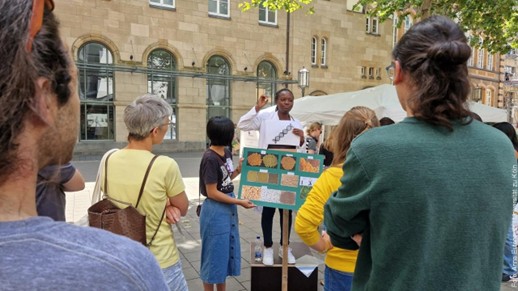
CEPLAS scientist, Mary Ngigi participating at the Soapbox Science Rheinland 2022, Bonn, Germany (Image by Mary Ngigi).
North America: Growing Knowledge, Growing Community
Across North America, community-based education continues to play a vital role in making science accessible and meaningful to the public (National Academies of Sciences, Engineering, and Medicine, 2016). For Olayemi Ojeokun, a science communicator and graduate researcher at Kansas State University, community engagement again came to life through her volunteer work with the Kansas 4-H Youth Program in 2024. As an assistant facilitator, she introduced elementary students to the foundational science behind plants and soils, guiding the students on growing and maintaining a small garden that would supply the school, their family, and the local food pantry, ultimately bridging classroom learning with hands-on community gardening.
A moment that particularly stood out was when a seven-year-old student proudly explained to a local pantry volunteer how compost improves tomato size and taste and then handed over a basket of freshly harvested tomatoes, which ultimately boosted the child’s self-confidence. That simple act embodies the power of community engagement in plant science outreach programmes. As Olayemi relates, pairing clear science instruction with practical, repeatable tasks and community partnership creates confident stewards and measurable benefits that outlast a single project.
When asked about what makes people connect emotionally to plant science, Olayemi, whose most rewarding science communication moment comes from when her audience can turn around to teach others, reflected on the power of everyday relevance.
“People connect emotionally to plant science when they can touch and participate in outcomes that matter to their daily lives and community. Hands-on activities like community gardening, composting, and simple soil tests make abstract ideas tangible, while community engagement turns individual learning into shared purpose and visible impact through joint projects and harvest events.” – Olayemi Ojeokun
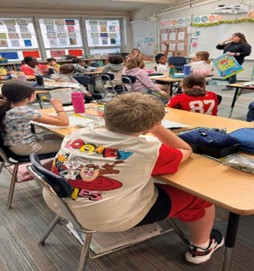
Kansas 4-H Youth Program Science Communication Event (Image by Olayemi Ojeokun)
Olayemi’s experience aligns with the broader findings that community-driven, participatory models of science communication foster long-term engagement and trust (Ballard and Belsky, 2010; Illingworth and Allen, 2016). In the North American context, where agricultural education and outreach have long been cornerstones of public science, initiatives like the 4-H Youth Program, Master Gardener programs, and citizen science networks continue to grow the next generation of environmentally conscious citizens, one garden bed at a time—encouraging the next generation not only to appreciate plants but to see themselves as part of the solution to food and climate challenges.
Africa: Cultivating Curiosity Through Local Engagement
Across Africa, science communication is gaining momentum as plant scientists bridge the gap between laboratory work and community understanding. With limited platforms for public engagement, plant scientists still find creative ways to spark curiosity and make science relatable to everyday experiences.
To promote agriculture and the science of nematology in Nigeria, Professor Biodun Claudius-Cole of the University of Ibadan, Nigeria, leads a team of budding nematologists to a high school in Ibadan, Nigeria. This engaging and highly informative outreach aimed to introduce high school students and teachers to the fascinating world of nematodes, educating them on the harmful and beneficial roles of nematodes in the environment, and encouraging these young folks to consider a career in plant science and ultimately nematology, an unpopular science in Nigeria.
As part of the event was a grand opportunity that allowed the students and teachers to observe nematodes directly under the microscope. This practical session focused on the extraction of the yam nematode, Scutellonema bradys, from an infected yam right in front of the audience. The participants were able to see firsthand the unique nature of these nematodes as they moved graciously under the microscope, making the concepts discussed during the event come to life!
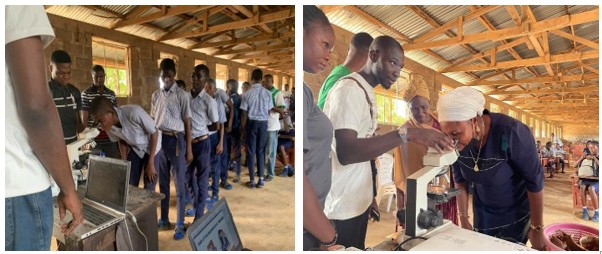
High School students, teachers, and school management observing the yam nematode, Scutellonema brady,s under the microscope during the outreach programme (Image by Nathaniel Oragbon)
The nematology outreach programme spearheaded by Professor Biodun Claudius-Cole and her team of final-year nematology students of the University of Ibadan, Nigeria, not only educated the students and teachers about the harmful and beneficial roles of nematodes in the environment but also encouraged these young folks to consider careers in plant science and ultimately nematology. We can continue to promote plant science through programmes like this. This also ensures that the future generations are equipped with the knowledge and zeal required to promote sustainable agriculture! Despite limited funding and infrastructure for science communication in many African countries, efforts like this highlight the innovation and resilience of scientists.
Australia: Blending Research, Culture, and Community
In Australia, science communication in plant and agricultural sciences has evolved through partnerships between universities, research agencies, and local communities. Community engagement often extends beyond laboratories and lecture halls into rural schools, regional agricultural shows, and farmer-led field days, where scientists and producers learn from each other in real time. This two-way dialogue helps bridge scientific innovation with practical on-farm applications, reflecting the spirit of co-creation that underpins effective engagement.
A powerful example of this approach is seen through programs like the Researchers in Agriculture for International Development (RAID) Network—an initiative supported by the Crawford Fund and the Australian Centre for International Agricultural Research (ACIAR). RAID connects young researchers with farmers, policymakers, and educators across Australia and the Indo-Pacific region to share knowledge about sustainable agriculture, crop improvement, and food security. Events organized by RAID often combine interactive discussions, storytelling, and regional networking, demonstrating how science can thrive when embedded within communities that share both challenges and solutions.
A great example of this international collaboration is the RAID Australian Vietnamese Partnership (Williams 2025), developed by RAID, the Crawford Fund, and the Australian Volunteers Program. Since 2020, it has connected young researchers from both countries through online and in-country volunteering, training, and co-designed agricultural projects. This partnership highlights how science communication and participatory research can strengthen capacity and mutual understanding across borders.
RAID Australian Vietnamese Partnership team in Vietnam
Similarly, universities like the University of Southern Queensland (UniSQ) and the University of Queensland (UQ) regularly host “Ag in the Classroom” initiatives and regional science outreach programs, enabling school students and teachers in rural areas to engage directly with researchers. These activities make plant science accessible and relatable, particularly in areas where agriculture shapes local identity and economy. In some events, Indigenous educators also collaborate to share traditional ecological knowledge, creating space for cultural perspectives in scientific storytelling. Such efforts highlight that Australian science communication is deeply rooted in collaboration, inclusivity, and respect for diverse ways of knowing. By merging Western scientific methods with traditional and local experiences, Australia offers a model for how science can be communicated in culturally meaningful and community-driven ways.
Whether through Europe’s public engagement platforms, North America’s educational partnerships, Africa’s grassroots initiatives, or Australia’s community-engaged initiatives, a common thread emerges-science communication is most effective when it values mutual learning. Around the world, plant scientists are finding creative ways to blend cultural context with scientific accuracy, showing that engagement is not a one-size-fits-all model but a spectrum of shared understanding.
Conclusion: Rooted in Connection, Growing Through Engagement
Across the four continents this article explored (Europe, North America, Africa, and Australia) these stories reveal that effective science communication is not defined by geography but by empathy, creativity, and engagement. From Mary Ngigi’s engaging street talk in Germany that helped adults connect plant nutrition to human health, to Olayemi Ojeokun’s inspiring work with elementary students in the United States, to Professor Biodun Claudius-Cole’s nematology awareness program in Nigeria, Africa, and finally to community-driven initiatives and field outreach in Australia, each example shows how plant science becomes truly powerful when it is shared beyond the lab.
What unites these experiences is a shared commitment to connection. When researchers listen to communities, invite their participation, and communicate with clarity and care, science becomes a collective journey rather than a one-way transfer of knowledge. These examples also demonstrate that impactful engagement does not require large budgets or advanced technology, only curiosity, creativity, and the willingness to meet people where they are.
By weaving together public engagement in Europe, community education in North America, grassroots outreach in Africa, and collaborative field learning in Australia, we see that plant science communication thrives on diversity. Furthermore, scientists need to view science communication as an extension of their research impact. When we make science tangible, relatable, and inclusive, we nurture not only knowledge but also ownership and trust. In doing so, we plant seeds of curiosity that help people see plant science not as abstract research, but as a shared human story—rooted in curiosity, community, and care for our planet.
References
Australian Centre for International Agricultural Research (ACIAR). (2025). About ACIAR. Retrieved October 8, 2025, from https://www.aciar.gov.au
Ballard, H. L., & Belsky, J. M. (2010). Participatory action research and environmental learning: Implications for resilient forests and communities. Environmental Education Research, 16(5–6), 611–627. https://doi.org/10.1080/13504622.2010.505440
Boakes, E. H., Pettorelli, N., & Sumner, S. (2021). Giving women a public voice helps tackle gender inequality in science [Report]. Soapbox Science. https://soapboxscience.org/wp-content/uploads/2021/02/Soapbox-Science-report-February-2021-1.pdf
Crawford Fund. (2025). About the Crawford Fund. Retrieved October 8, 2025, from https://www.crawfordfund.org
Illingworth, S., & Allen, G. (2016). Effective science communication: A practical guide to surviving as a scientist. IOP Publishing. https://iopscience.iop.org/book/mono/978-0-7503-1170-0.pdf
Kansas State University 4-H. (2025, September 19). Plant Sciences (4-H project). Retrieved October 7, 2025, from https://www.kansas4-h.org/projects/plant-environmental-science/
National Academies of Sciences, Engineering, and Medicine. (2016). Science Literacy: Concepts, Contexts, and Consequences. The National Academies Press. https://doi.org/10.17226/23595
Plantae. (n.d.). Science communication and public understanding. American Society of Plant Biologists. Retrieved September 1, 2025, from https://plantae.org/science-communication-and-public-understanding/
Researchers in Agriculture for International Development (RAID) Network. (2025). About RAID – Connecting researchers in agriculture for international development. Retrieved October 8, 2025, from https://www.raidnetwork.crawfordfund.org
WHO. (2021). Anaemia. World Health Organization. https://www.who.int/news-room/fact-sheets/detail/anaemia
Williams, M. (2025). RAID Network Australian and Vietnamese Partnership. RAID Network, Crawford Fund. Retrieved October 22, 2025, from https://raidnetwork.crawfordfund.org/news/raid-network-australian-and-vietnamese-partnership/
______________________________________________
About the Authors
Krishna Chaitanya Alamuru
Krishna is cPhD student at the University of Southern Queensland and a 2025 Plantae Fellows. He specializes in plant pathology, genomics, and genetics. Krishna is passionate about applying advanced molecular techniques to enhance sustainable agricultural practices and crop resilience. X: @alamuru_krishna | LinkedIn:linkedin.com/in/alamuru02
Nathaniel Oragbon
Nathaniel is currently a graduate student of Heinrich Heine University Düsseldorf, Germany and a member of CEPLAS Graduate School, Germany and a 2025 Plantae Fellows.. His previous research focused on plant-nematode interactions and insect-nematode interactions. Nathaniel is passionate about science communication and hopes to further develop this skill. In his free time, he enjoys both watching and playing soccer. X: @NathanIgwe

