

Ancient human disturbances may be skewing our understanding of Amazonian forests ($)
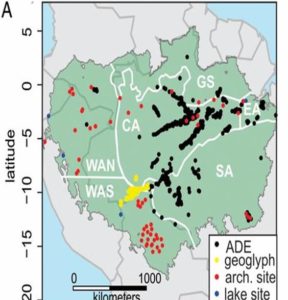 The Amazonian forest is an enormous and crucial ecosystem that encompasses a huge proportion of Earth’s biodiversity and stored carbon. By overlaying maps showing forest inventory plots and sites of ancient human impact, McMichael et al. observe that the inventoried plots from which we draw conclusions about forest composition and dynamics may be skewed towards places that have been sites of ancient human impact; for example, both are biased towards accessible regions of forest near waterways. This overlap may skew our assumptions about “undisturbed” forest, as many studied sites may only be a tree generation or two into succession. The authors argue that the location of future study sites in Amazonia and other forests should take into consideration whether these sites were affected by ancient human impacts. Proc. Natl. Acad. Sci. USA 10.1073/pnas.1614577114
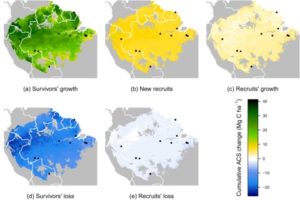 The Amazon rainforest stores 30% of land-based ecosystem carbon. How are carbon stores affected by selective tree removal and subsequent regrowth? Stored carbon continues to be lost for several years after logging due to damage-associated mortality of surviving trees. Piponoit et al. use data from more than one hundred Amazonian forest plots to examine how selective logging affects above-ground carbon stores, particularly its effects on growth and mortality of surviving trees as well as growth of new trees. Not surprisingly, the rate of recovery of stored carbon is influenced by region within the forest, with a faster recovery occurring in regions with milder climates. Furthermore, the authors observe that recruited trees that replace logged trees are often species that are more vulnerable to water stress and therefore offer less long-term resilience than trees that were removed. These observations can inform forest management planning. eLIFE
 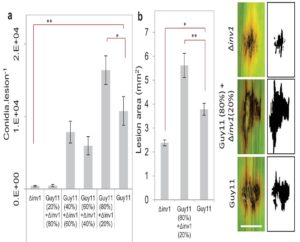 Disease-causing organisms attack as a population of diverse individuals. Is it possible to reduce the virulence of this population by introducing less-virulent individuals? Some studies have shown such an effect; as an example, application of low-virulence strains of Aspergillus flavus can protect crops by competing with virulent, toxin-producing strains. Lindsay et al. explore this question further, focusing on the interaction between rice and the rice blast fungus Magnaporthe oryzae. In this study, they introduced a less virulent “public good” mutant (a mutant that fails to contribute to the overall well-being of the population), and found, contrary to expectations, that the overall population became more virulent. The authors conclude that disease suppression efforts must include considerations of the social interactions of the pathogens. eLIFE
 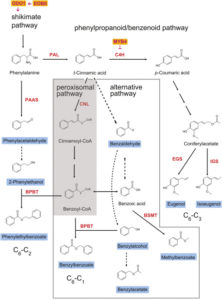 Two papers in Current Biology examine the genetics behind plant-pollinator interactions , focusing on genes controlling floral scent. Amrad et al.
 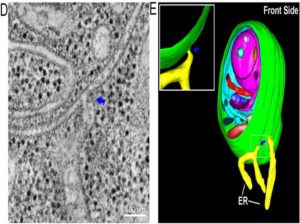 The autophagosome, a cellular compartment involved in the turnover of macromolecules, contributes to nutrient homeostasis, stress resilience and defense. Although several proteins have been identified as contributing to autophagosome formation and function, the precise origins of the autophagosome have remained unclear. Using imaging, labeling and Arabidopsis mutants, Zhuang et al. show that the autophagosomal membrane is a clear outgrowth from an ER subdomain and that ATG9, a lipid-embedded protein, is essential for ER-derived autophagosome formation. Proc. Natl. Acad. Sci. USA
 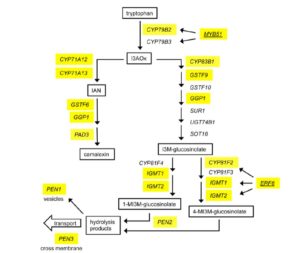 Plants perceive microbial pathogens though cell-surface receptors that recognize conserved microbial patterns such as flagellin. Previous studies have identified the WRKY family of transcription factors as contributors to Microbial-Associated Molecular Pattern (MAMP)-Triggered Immunity (MTI). Birkenbihl et al. use chromatin-immunoprecipitation to identify direct targets of three WRKY transcription factors following stimulation by the MAMP peptide flg-22. Their study reveals some overlap in the targets of two of the WRKYs (WRKY18 and WRKY40), and also some overlap with genes induced by damage in the Damage-Associated Molecular Pattern response. Other classes of WRKY targets include genes involved in production of defense compounds such as camalexin and indole glucosinolates, and genes involved in hormone (e.g., ethylene, salicylic acid, jasmonic acid) responses. This work provides an important dataset to expand our understanding of plant immunity. Plant Cell
  When a plant species is introduced to a new region, it brings with it “hitchhikers” – other associated organisms. Sometimes, these hitchhikers negatively impact the environment into which they are introduced, for example by facilitating the host’s invasiveness, or through direct detrimental effects (such as pathogenicity) on native plants. Factors that determine whether a hitchhiker will be harmful include how likely it is to shift to a new host and its life history strategy. Burgess et al. review the possible outcomes of fungal hitchhikers during tree invasions, and argue that this is a facet of invasion biology that has been understudied. AoB Plants
 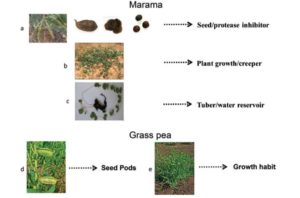 Orphan legumes, which include cowpea (Vigna unguiculata), Bambara groundnut (V. subterranea), grass pea (Lathyrus sativus) and marama bean (Tylosema esculentum), are important food sources for many farmers, but have largely been ignored by breeders and industry. Cullis and Kunert argue that some of these species can provide traits such as drought tolerance to benefit major crop breeding programs, and also that some compounds of pharmaceutical value can be found in orphan legumes. Their review focuses on marama bean and grass pea, and provides insights into efforts to apply molecular breeding and other approaches to orphan crops to unlock their potential. J. Exp. Bot.
 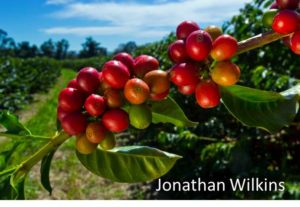 Coffee is a hugely popular beverage and contributes immeasurably to human productivity, but demand has risen by 50% in the past 20 years while coffee production is vulnerable to disease and climate change. Mehrabi and Lashermes observe that the popular arabica coffee comes from the plant Coffea arabica, which arose in Ethiopia from a hybridization of two other species 10,000 – 50,000 years ago. Ethiopia remains the center of coffee genetic diversity, but without concerted efforts, that diversity is likely to be eroded. The authors point out that economic challenges faced by coffee growers in Ethiopia, and their accompanying need to explore other crop systems, can contribute to removal of wild coffee populations. They also point to the lack of infrastructure and support to ensure the conservation of coffee’s genetic diversity. They conclude “Dealing with these local challenges should be a global priority for the coffee industry”. Nature Plants