
Oxygen: A hidden developmental cue in leaf morphogenesis
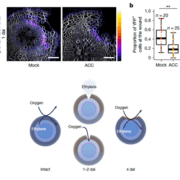
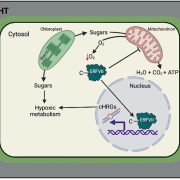
 Oxygen is always considered something living forms need to survive. But wait, its role is beyond just respiration. Would you believe if I told you oxygen guides the development of young leaves? A recent study by Panicucci et al. reveals that oxygen acts as a signalling molecule, affecting cell proliferation and differentiation during leaf development. New leaves maintain low oxygen as they emerge from the shoot apical meristem, and progressive oxygenation creates an oxygen gradient from the distal to proximal base that helps in shaping leaf development. To investigate how this oxygen gradient affects development, the authors observed Arabidopsis leaf development under modified oxygen atmospheres. Hypoxia (4% O₂) caused complex, deeply serrated leaves, while hyperoxia (40% O₂) resulted in reduced leaf size. The authors also linked this effect to the Cys branch of the N-degron (oxygen-sensing) pathway, in which plant cysteine oxidases (PCOs) perceive hypoxia and stabilize ERFVII transcription factors. Interestingly, PCO mutant plants showed persistent hypoxia signalling with smaller, rounder, and more highly serrated leaves. Transcriptomic and cellular phenotyping showed impaired stomatal complexes, trichome patterning and chlorophyll biosynthesis, and inhibiting ERFVII rescued these phenotypes. Together, the findings position oxygen as a positional cue that influences leaf morphology. (Summary by Priyanka Babuta) Science Advances 10.1126/sciadv.aef2430