
How chromatin changes shift CHH methylation pathways in soybean
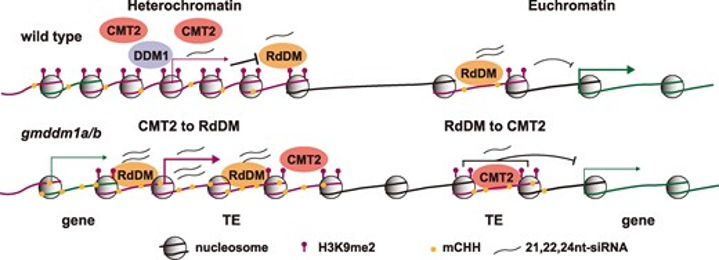 DECREASED IN DNA METHYLATION 1 (DDM1) is a chromatin remodeler that regulates nucleosome organization and facilitates access of DNA methyltransferases to heterochromatic regions enriched in transposable elements (TEs), contributing to DNA methylation, TE silencing, and genome stability. In plants, CHH methylation is established and maintained through distinct pathways operating in different chromatin contexts: CHROMOMETHYLASE 2 (CMT2) primarily targets heterochromatic regions enriched in H3K9me2 and associated with long TEs, whereas RNA-directed DNA methylation (RdDM) contributes to CHH methylation in more accessible regions, including small TEs and the ends of long TEs. Cao et al. investigated how changes in DDM1-dependent chromatin organization affect these patterns in soybean by generating ddm1a, ddm1b, and ddm1a/b mutants and profiling chromatin states, histone modifications, DNA methylation, 24-nt siRNAs, and gene expression. While the single mutants were similar to the wild type, the ddm1a/b mutant showed impaired growth and failed to complete its life cycle, indicating redundant functions of the two DDM1 homologs and an essential role for DDM1 in soybean growth and development. Loss of DDM1 caused genome-wide chromatin homogenization, with heterochromatin becoming more relaxed and euchromatin more condensed. This altered chromatin architecture changed where CMT2 and RdDM were more active: in relaxed heterochromatin, increased small RNA release promoted the RdDM pathway in regions of long TEs normally associated with CMT2, whereas TEs in more condensed euchromatin became enriched in CMT2 activity. This “CMT2-to-RdDM switch” resulted in a genome-wide increase in CHH methylation and transcriptional dysregulation, including increased expression of stress-response genes and reduced expression of photosynthesis-related genes, leading to a severe phenotype in ddm1a/b plants. Together, these findings reveal how chromatin organization can reshape CHH methylation pathways in plants. (Summary by Flavia Darqui @flavia-darqui.bsky.social) Plant Cell 10.1093/plcell/koag250