

Staying Sane in the Lab: Tips for Mental Health Strategies for Researchers
It’s 10:30 p.m. and your laptop is still open. The submission deadline is tomorrow, your latest experiment failed, and your email inbox is a small avalanche. You silently wonder how long you can keep this up — and how everyone else seems to handle it better than you. Even though it can often feel like it, you are not alone. Studies show that 40–50% of PhD students meet the criteria of depression and anxiety (Levecque et al., 2017; Evans et al., 2018). That tells us that mental health is a huge challenge among scientists, but is rather treated like a “silent crisis.” No wonder, since we have to juggle short-term contracts, high competition, unclear career paths, and the publish-or-perish culture. It could often lead to the feeling that you just need to “toughen up” your game to persist in this world. You might think that that is what resilience is like, but it is not. Resilience in academia isn’t about becoming unbreakable — it’s about learning to adapt, protect your wellbeing, and thrive in a system that often tests your limits. In this blog post, we want to explore realistic strategies for building resilience and protecting your mental health while sustaining your passion for research.
Work–life balance
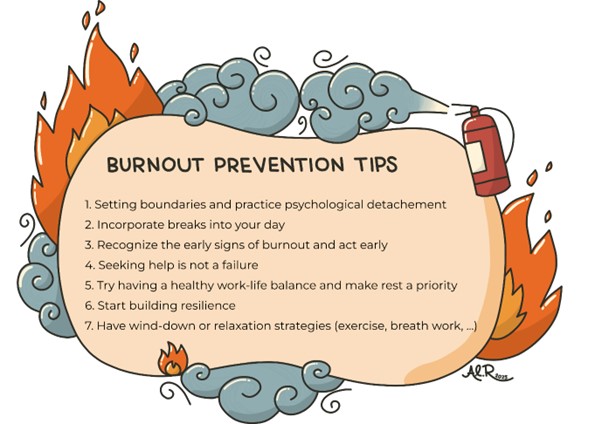
A first step is to look at the foundation of how we work. Like the terms gratitude and self-care, work–life balance is often used so frequently it risks losing its meaning. Yet a healthy work–life balance is essential for our resilience: chronic overwork is strongly linked to burnout, reduced productivity, and in the worst case to serious mental health problems (Bodendieck et al., 2022). In academia, supervisors and peers may unintentionally model unhealthy habits, creating a norm of overwork. It can feel as if evenings and weekends are “optional work shifts” needed to meet deadlines, and many researchers even feel guilty for not working constantly. That means learning to set boundaries and prioritising rest over guilt. Setting boundaries isn’t selfish — in fact, it’s a form of professional maintenance. That might mean protecting your weekends, or scheduling hobbies with the same seriousness you’d give a lab meeting. Work–life balance isn’t about working less; it’s about working sustainably so you can keep doing great research in the long run.
Time and energy management
Of course, balance is easier to sustain when our daily structure supports it. The workload during a PhD or postdoc can be overwhelming, and most researchers would agree on that. However, we often make it harder for ourselves. Many people start their day in the lab without a clear agenda, spending the fresh energy of the morning on emails, social media, or the next cat video. I fell into this trap early in my PhD until it became mental chaos. One of the simplest yet most effective tools I have found is the humble to-do list. It does not matter whether it is on paper, in a calendar, or in a digital app; what matters is having it. I now start each lab day with a cup of coffee and a clear plan for my duties and tasks. On a monthly basis, I use Asana, a web platform for work management, to plan experiments and writing projects, setting realistic deadlines. Some people prefer a weekly schedule with dedicated themes for each day, such as Monday for writing, Tuesday for experiments, and Wednesday for data analysis. Whether your work is in the lab or purely computational, the key is to find what works for you and stick with it. There is nothing more satisfying than checking something off the list, and in my experience, this structure creates more free time than simply improvising.
Mind, breath, and body
Still, even the best schedule can collapse under pressure if we don’t care for our mind and body. Meditation and mindfulness-based programs have been shown to reduce stress and improve well-being in the general population (Marais et al., 2020). A meta-analysis found that in 19 of 21 studies, mindfulness interventions had a significant positive effect on mental health of university students (González-Martín et al., 2023). Mindfulness is not about making problems disappear. It is about observing thoughts as they are and avoiding overwhelm when deadlines approach. It can help academics focus on the task at hand and reduce task completion time by increasing attentional resources (Marais et al., 2020). But for some, just sitting still can feel intimidating. Here, focusing on the breath can be a more accessible entry point. A quick breathing exercise I use under stress is to: sit upright, inhale deeply through your nose, pause, take another small sip of air, then exhale slowly through your nose, pausing again at the bottom. Notice any shift. Others may benefit more from movement. Yoga connects mind, body, and breath, and practices such as yoga nidra may promote relaxation and better sleep (Moszeik et al., 2022). Importantly, these practices do not require a huge amount of free time. Even 5 to 10 minutes of stretching between writing sessions can make a difference. Free resources are abundant online, and many universities offer affordable or free yoga or meditation classes.
Protect your brain like your best experiment
Think of your brain as your most valuable reagent. No one leaves enzymes out on the bench — don’t leave your mental energy lying around for anyone to waste. And let’s be honest: research is 50% science, 25% administrative chaos, and 25% wondering why your experiment didn’t work (yes, the math checks out, ask any PhD). The grind can be glorious — and it can chew you up if you’re not careful. Say no sometimes. Yes, even to your PI. Especially to your PI. Practice psychological detachment after work hours (which means no to “just checking data at 23:47”). That off-switch in our brains is a recovery skill, not a luxury (Olafsen et al., 2020). Late-night reviewer-2 rereads, inbox refreshes, Slack pings during dinner? That’s not dedication, that’s a cortisol drip. After-hours digital work and constant interruptions tank detachment, raise strain, and predict burnout (Mark et al., 2008).
Breaks are not a weakness and micro-joys matter
The most productive people in science are not the ones chained to the bench. They’re the ones who know when to walk away. Stand up, get a tea, stare at the ugliest lab poster, have dedicated coffee rituals, and don’t forget to water that one plant in the corner. Tiny anchors in the day widen attention and build resilience. Think about the first sip of your morning coffee, the lab plant you haven’t killed, the new Linkin Park single. Savor them on purpose — that brief positive effect is a measurable buffer (Cullen et al., 2024). Your neurons need downtime to connect dots. Brains sprint, they don’t marathon. Regular micro-breaks improve vigor, cut fatigue, and can nudge performance for the better, especially on repetitive or attention-heavy work (Albulescu et al., 2022). Plan intervals, protect your lunch time, and walk away before your pipette starts feeling personal.
Know the signs and seek help early
Finally, resilience also means recognising when strategies aren’t enough. Therapy ≠ failure, it’s maintenance. The classic burnout triad includes exhaustion, cynicism/mental distance, and reduced efficacy. Notice irritability, memory slips, and the creeping thought that “I hate everything.” Fridays bleeding into Mondays. Treat these like contamination and act early. Have friends who have no idea what your research is about. Play music, run, bake, hike — do something that is not peer-reviewable. And if nothing helps, just as you would see a doctor for chronic back pain, your mind deserves the same respect. Many universities have free or low-cost counselling, use it before you’re in full breakdown mode. Evidence-based therapies work, and campus counselling helps students (Cuijpers et al., 2021). During my PhD, Managing Your Mental Health During Your PhD by Zoë J. Ayres was the book that reminded me I wasn’t alone, and that surviving academia is as much about mindset as it is a skillset.
Final thoughts
Caring for our mental health in academia is not a luxury, but rather a foundation for sustainable and fulfilling research careers. As scientists, we often face high expectations, uncertainty, and the temptation to overwork, yet resilience does not mean pushing ourselves past our limits. It means finding balance, building support networks, managing our time and energy wisely, and nurturing body and mind through restorative practices. By taking small but consistent steps, we not only take care of our own well-being but also contribute to a healthier academic culture, one where passion for discovery can thrive without coming at the expense of mental health.
References
Albulescu, P., Macsinga, I., Rusu, A., Sulea, C., Bodnaru, A., Tulbure, B.T., 2022. “Give me a break!” A systematic review and meta-analysis on the efficacy of micro-breaks for increasing well-being and performance. PLOS ONE 17, e0272460. https://doi.org/10.1371/journal.pone.0272460
Bodendieck, E., Jung, F.U., Conrad, I., Riedel-Heller, S.G., Hussenoeder, F.S., 2022. The work-life balance of general practitioners as a predictor of burnout and motivation to stay in the profession. BMC Primary Care 23, 218. https://doi.org/10.1186/s12875-022-01831-7
Cuijpers, P., Quero, S., Noma, H., Ciharova, M., Miguel, C., Karyotaki, E., Cipriani, A., Cristea, I.A., Furukawa, T.A., 2021. Psychotherapies for depression: a network meta-analysis covering efficacy, acceptability and long-term outcomes of all main treatment types. World Psychiatry 20, 283–293. https://doi.org/10.1002/wps.20860
Cullen, K., Murphy, M., Blasi, Z.D., Bryant, F.B., 2024. The effectiveness of savouring interventions on well-being in adult clinical populations: A protocol for a systematic review. PLOS ONE 19, e0302014. https://doi.org/10.1371/journal.pone.0302014
Evans, T.M., Bira, L., Gastelum, J.B., Weiss, L.T., Vanderford, N.L., 2018. Evidence for a mental health crisis in graduate education. Nat Biotechnol 36, 282–284. https://doi.org/10.1038/nbt.4089
González-Martín, A.M., Aibar-Almazán, A., Rivas-Campo, Y., Castellote-Caballero, Y., Carcelén-Fraile, M. del C., 2023. Mindfulness to improve the mental health of university students. A systematic review and meta-analysis. Front. Public Health 11. https://doi.org/10.3389/fpubh.2023.1284632
Levecque, K., Anseel, F., De Beuckelaer, A., Van der Heyden, J., Gisle, L., 2017. Work organization and mental health problems in PhD students. Research Policy 46, 868–879. https://doi.org/10.1016/j.respol.2017.02.008
Marais, G.A.B., Lantheaume, S., Fiault, R., Shankland, R., 2020. Mindfulness-Based Programs Improve Psychological Flexibility, Mental Health, Well-Being, and Time Management in Academics. European Journal of Investigation in Health, Psychology and Education 10, 1035–1050. https://doi.org/10.3390/ejihpe10040073
Mark, G., Gudith, D., Klocke, U., 2008. The cost of interrupted work: more speed and stress, in: Proceedings of the SIGCHI Conference on Human Factors in Computing Systems, CHI ’08. Association for Computing Machinery, New York, NY, USA, pp. 107–110. https://doi.org/10.1145/1357054.1357072
Moszeik, E.N., von Oertzen, T., Renner, K.-H., 2022. Effectiveness of a short Yoga Nidra meditation on stress, sleep, and well-being in a large and diverse sample. Curr Psychol 41, 5272–5286. https://doi.org/10.1007/s12144-020-01042-2
Olafsen, A.H., Bentzen, M., 2020. Benefits of Psychological Detachment From Work: Does Autonomous Work Motivation Play a Role? Front. Psychol. 11. https://doi.org/10.3389/fpsyg.2020.00824
Riley, K.E., Park, C.L., 2015. How does yoga reduce stress? A systematic review of mechanisms of change and guide to future inquiry. Health Psychology Review 9, 379–396. https://doi.org/10.1080/17437199.2014.981778
______________________________________________
About the Authors
Katarina Kurtović
Katarina is a final-year PhD student at Charles University, Prague, Czech Republic and a 2025 Plantae Fellows. Her research focuses on the evolution of phytohormone auxin transport and response in algal relatives of land plants. When not in the lab, she teaches yoga, goes on hikes, plays with her cat, and visits Croatia where she is from. X: @kat_kurtovic.
Nibedita Priyadarshini
Nibedita is an algal biologist, and a 2024 Plantae Fellow. She has a passion for turning the world into her personal petri dish! When she’s not busy peering through microscopes or waxing poetic about the wonders of plant research, you can find her charming everyone with her quirky sense of humor and an uncanny ability to make phytohormones sound like the coolest party in town. You can find her on X: @nivi_pri.
Ann-Kathrin Rößling
Ann-Kathrin is a PhD student at the University of Freiburg in Germany, and a 2024 Plantae Fellow. She is researching intracellular mechanisms using confocal microscopy in Arabidopsis roots to gain a better understanding of vacuolar morphology. In addition to her scientific pursuits, she enjoys reading, both fiction and non-fiction, and is passionate about illustrations and artwork. You can find her on X: @AK_Roessling.

