

How to Build a Start-up in Plant Sciences
What is a start-up?
When you hear the word “start-up”, you might picture tech hubs, pitch decks, and overnight success stories. But what actually defines a start-up?
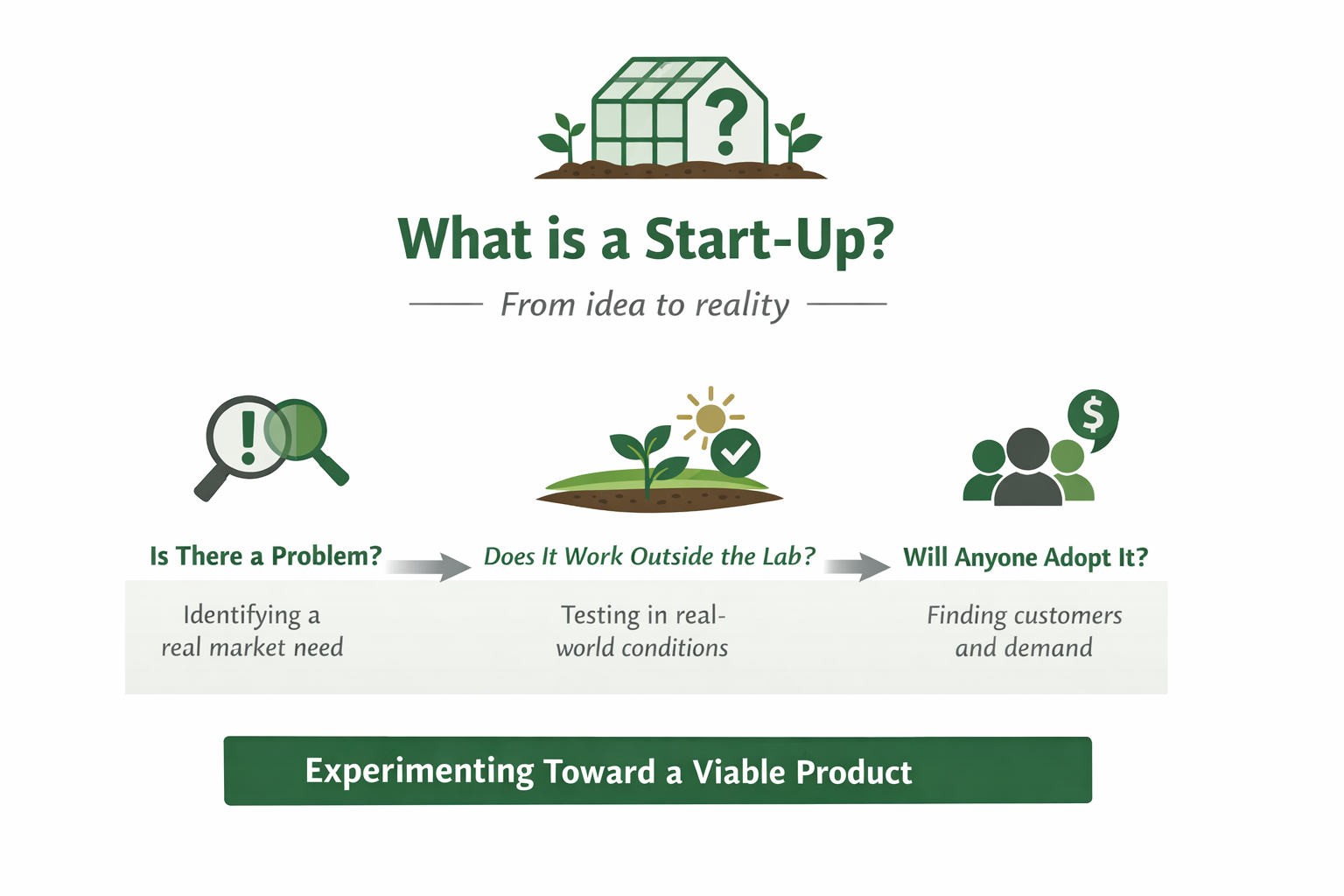
At its core, a start-up is a young company navigating high uncertainty while searching for a scalable and repeatable business model. Unlike traditional businesses that follow established paths, start-ups are built to experiment, innovate, and grow around unmet market problems (Pekevski, 2025; Grant, 2025).
For plant scientists, this should feel familiar. If you have ever designed an experiment under uncertainty, worked around constraints, or chased down why something failed, you have already practiced the core skills of entrepreneurship. The difference is that the experiment is no longer only biological. It becomes commercial, regulatory and practical at the same time.
A start-up is simply where the question is no longer “How does this work?” but “Does this matter enough to build around?”
Problem–solution fit and product–market fit
Start-ups do not begin with technology. They begin with a problem.
For researchers, this often means stepping back from the science and asking:
- Who actually experiences this problem?
- How are they solving it today?
- Why are those solutions not good enough?
- Would someone change what they are doing to use this instead?
These questions are rarely answered in the lab. They are answered in conversations with real people: Farmers, processors, agritech specialists, regulators, pretty much anyone who lives with the constraints your research may touch (Chen, 2025).
Once a real problem is identified, the goal becomes a problem–solution fit: does this idea meaningfully improve the situation?
Only then comes product–market fit: shaping the solution into something people are willing to pay for. This often starts with a simple prototype or minimum viable product (MVP) and a lot of feedback from early users. At this stage, learning matters the most! (Kumbhat & Sushil, 2018; Founders Forum Group, 2025).
The lesson is simple: If you need slides to explain the problem, you don’t have a start-up yet.
Reality of innovation: Timelines, regulation, scale, cost

Even with a clear problem and a promising solution, most plant science start-ups run into the same four walls: time, regulation, scale and cost.
Today, the plant science start-up landscape is rapidly expanding, with more than 11,000 agricultural start-ups worldwide (Tamanna, 2025). Plant / agtech start-ups typically take longer to mature than other emerging technologies like software, AI and even med tech (AgFunderNews). This is due to the nature of plant growth cycles, field validation, and multi-season testing; biological proof takes years, not months. Regulation adds another layer. A product acceptable in one country may face long approval timelines in another. For example, gene-edited crops are treated as non-GM in the United States, whereas in Europe, it is still facing stricter regulation. These differences shape where and how products can be deployed.
Furthermore, scale and cost are often underestimated. Producing something once in a lab is very different from producing it reliably, cheaply, and consistently at an agricultural or industrial scale.
You can see how these forces shaped real companies:
Pairwise, founded in 2017, proved that gene editing worked early. What has taken nearly a decade is proving it works in agriculture at scale, in a way growers, retailers and consumers value. The bottleneck was never biology. It was adoption.
Ginkgo Bioworks, founded in 2008, spent more than a decade building infrastructure and raising capital before going public in 2021. Their challenge was not whether biology could be engineered, but how to turn that capability into repeatable commercial products.
Amyris, founded in 2003, showed that using SynBio to make valuable plant molecules sustainably is possible. Yet despite the science, the company went bankrupt and faced financial restructuring in 2023. The science worked. The business model struggled.
None of these were overnight successes. All of them spent years reducing risk outside the lab.
This is what plant science entrepreneurship really looks like.
Understanding these constraints should not discourage entrepreneurship. In fact, they explain why plant scientists are often better prepared for start-ups than they realise.
From Researcher to Founder
The habits that make you a good scientist are the same ones that make you capable of building a start-up.
As scientists, we are trained to ask, “How does this work?” “Can I prove this?”
“What does the data say?” “Is this correct?”
As a founder, the questions change to: “Is this worth building around?” “Should I keep investing in this?” “What decision does the data allow me to make?” “Is this useful?”
That shift might sound large, but in practice, many of the core skills are the same.
Think about what you already do in research:
- work under uncertainty
- design experiments to reduce unknowns
- make decisions based on incomplete data
- manage constraints of time, resources, and funding
- interpret messy results and decide what to do next
- explain complex ideas to non-specialists
This is exactly what founders do.
The difference is not the skillset. It is the context.
In research, progress comes from depth. You design careful experiments, add controls, and chase every interesting variable. You are rewarded for precision and completeness.
In a start-up, progress comes from learning just enough to decide the next step. Killing bad ideas quickly is a success metric. Experiments are no longer designed to explore everything that might be interesting, but to answer one uncomfortable question at a time.
At first, this feels wrong. Letting go of “perfect” data can feel like lowering standards. But in the start-up world, a clean experiment that says stop is more valuable than a beautiful dataset that leads nowhere.
This is particularly true for plant science start-ups: Long timelines, regulation, and scale mean that early choices echo for years. Learning to prioritise, communicate clearly, and move forward with limited information on a ticking clock can be the make-or-break.
If you are wondering whether start-ups are “for people like me”, the answer is often yes. Start-ups aren’t built by “business people”. They are built by people who understand systems, constraints, and uncertainty — in other words, scientists.
The transition is not about abandoning good science. It is about giving your science a chance to leave the lab and do some work in the real world.
RESOURCE: Where to go for support
If you’re curious about start-ups, you don’t need to figure this out alone. A surprising amount of support already exists: You just need to know where to look. We’ve compiled a list of resources you could consider first:
Funding
Grants & proof-of-concept
- University proof-of-concept / translational funds
- National research councils’ translation schemes
- Government innovation agencies (e.g., SBIR/STTR in the US; Innovate UK; Horizon Europe / EIC in EU)
- Agriculture-specific innovation calls (soil, inputs, breeding, sustainability)
- Innovation competitions and prize funds
- Philanthropic foundations e.g. funding food, climate, and agriculture
Early equity
- University-linked seed funds
- Angel networks (often regional, agriculture- or biotech-focused)
- Pre-seed/seed VCs specialising in ag, climate, bio, or deep tech
- Corporate venture arms of agribusiness, food, and ingredients companies
- Ag/biotech accelerators and incubators
- Venture studios attached to universities or research parks
Intellectual Property (IP)
Things to remember
- Rules differ by country
- Public disclosure (abstracts, posters, talks, LinkedIn) can void protection
- Timing of filings vs publications matters
Who to speak to first
- University Technology Transfer Office (TTO)
- Patent attorney
Protection routes
- Patents (traits, methods, enabling tech)
- Trade secrets (processes, know-how)
- Plant Variety Protection (PVP) / Plant Breeders’ Rights
- Material Transfer Agreements (MTAs) for sharing materials safely
- Non-Disclosure Agreements (NDAs) for early conversations
Training and mentorship
- Customer discovery / I-Corps programmes
- Short courses in entrepreneurship for scientists
- Pitch training and investor communication workshops
- Regulatory basics for ag/biotech
- Cost of goods (COGs) and scale-up workshops
- IP and commercialisation seminars
- Alumni founder talks and mentoring circles
Additional Plantae Resources
- Mukherjee, A. (2024, January 22). Entrepreneurships in plant science https://plantae.org/entrepreneurships-in-plant-science/
- Plantae. Plant Science for Startups. (2024, February 9) https://plantae.org/plantaepresents-plant-science-for-startups/
- Careers in Plant Biology Startups. (2020, November 12) https://plantae.org/73221-2/
References
Ag Funder News Annual Report 2024 https://agfundernews.com/
Chen, X. (2025). The role of modern agricultural technologies in improving agricultural productivity and land use efficiency. Frontiers in Plant Science,16-2025. https://doi.org/10.3389/fpls.2025.1675657
Founders Forum Group. The ultimate startup guide with statistics (2024–2025). (2025, May 9). Founders Forum Group. https://ff.co/startup-statistics-guide/
Grant, M. (2025, September 20). Understanding startups: How to successfully launch a new business. Investopedia. https://www.investopedia.com/terms/s/startup.asp
Kumbhat, A. & Sushil, (2018). Development stages and scaling issues of startups. In Dhir, S., & Sushil (Eds), Flexible strategies in VUCA markets (pp 3-15). Springer. https://doi.org/10.1007/978-981-10-8926-8_1
Pekevski, S. (2025). What is a startup?. Management Studies, 13, 68-78. https://doi.org/10.17265/2328-2185/2025.02.002
Tamanna, Y. (2025, December 18). Agriculture report 2026: Industry data & insights. StartUs Insights. https://www.startus-insights.com/innovators-guide/agriculture-report/
______________________________________________
About the Authors
Charlay Wood
Charlay is a postdoctoral researcher at the University of Wisconsin–Madison and a 2026 Plantae Fellow . Her research is a blend of plant biochemistry and synthetic biology, where she engineers crops to both capture more atmospheric carbon and transform it into high-value aromatic compounds. Find her on LinkedIn and X: @Charlaywood.
Fengoula Avgeri
Fengoula is a recent PhD graduate in Plant Molecular Biology from the Agricultural University of Athens, Greece and a 2026 Plantae Fellow. Her research expertise focuses on plant proteostasis and mitochondrial biology, while she sees science as an adventure without boundaries. Beyond her scientific pursuits, she enjoys the company of a good book, hiking in nature, and creating illustrations. Find her on Bluesky: @fengoulaavgeri.bsky.social and X: @AvgeriF.
