How salicylic acid switches plant defence genes on and off
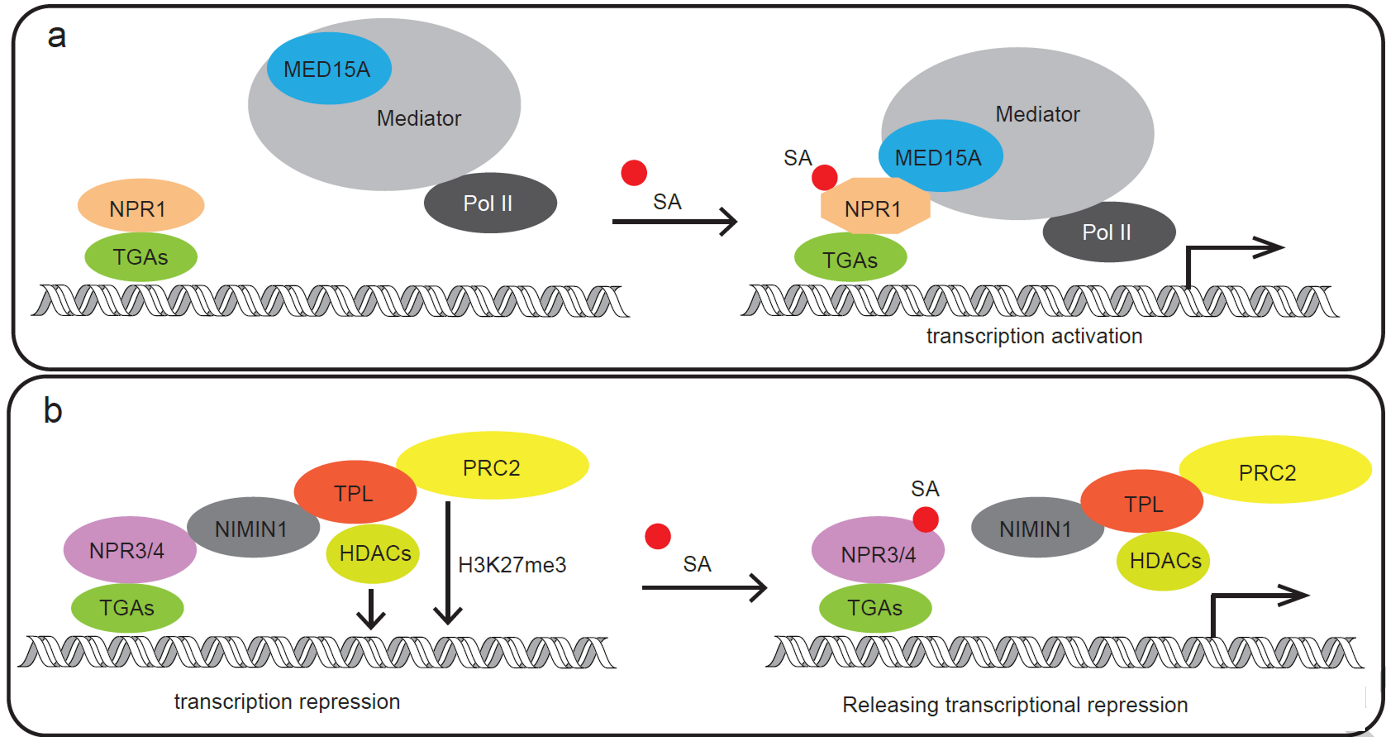 Salicylic acid (SA) is a plant hormone that plays a central role in defence against pathogens. In Arabidopsis thaliana, SA is perceived by NPR1, NPR3 and NPR4, but how these receptors regulate defence gene expression has remained unclear. Peng et al. show how SA promotes transcriptional activation through NPR1 while relieving repression mediated by NPR3 and NPR4. Using protein-interaction and structural analyses, the authors identified Mediator Complex Subunit 15A (MED15A) as an NPR1 partner. SA promotes their interaction through the KIX domain of MED15A, linking NPR1 to the Mediator complex and supporting defence gene activation. The authors also found that the regulatory protein NIMIN1 connects NPR3/NPR4 to the transcriptional co-repressor TOPLESS and Polycomb Repressive Complex 2. This pathway promotes the repressive histone modification H3K27me3 at SA-responsive genes. Using ChIP-qPCR, the authors examined changes in H3K27me3 and histone acetylation at these genes. SA disrupts the NPR3/NPR4–NIMIN1 interaction, decreasing H3K27me3 and increasing histone acetylation. These changes help relieve transcriptional repression and promote defence gene expression. Together, the findings explain how SA coordinates transcriptional activation and repression through distinct receptor pathways. Understanding these mechanisms could help researchers develop strategies to improve crop disease resistance by manipulating SA signalling while limiting the growth costs associated with prolonged defence activation. (Summary by Gourav Arora @gourav_arora_g) Nature 10.1038/s41586-026-11123-0