Do roots rely on damage signaling for effector-triggered immunity?
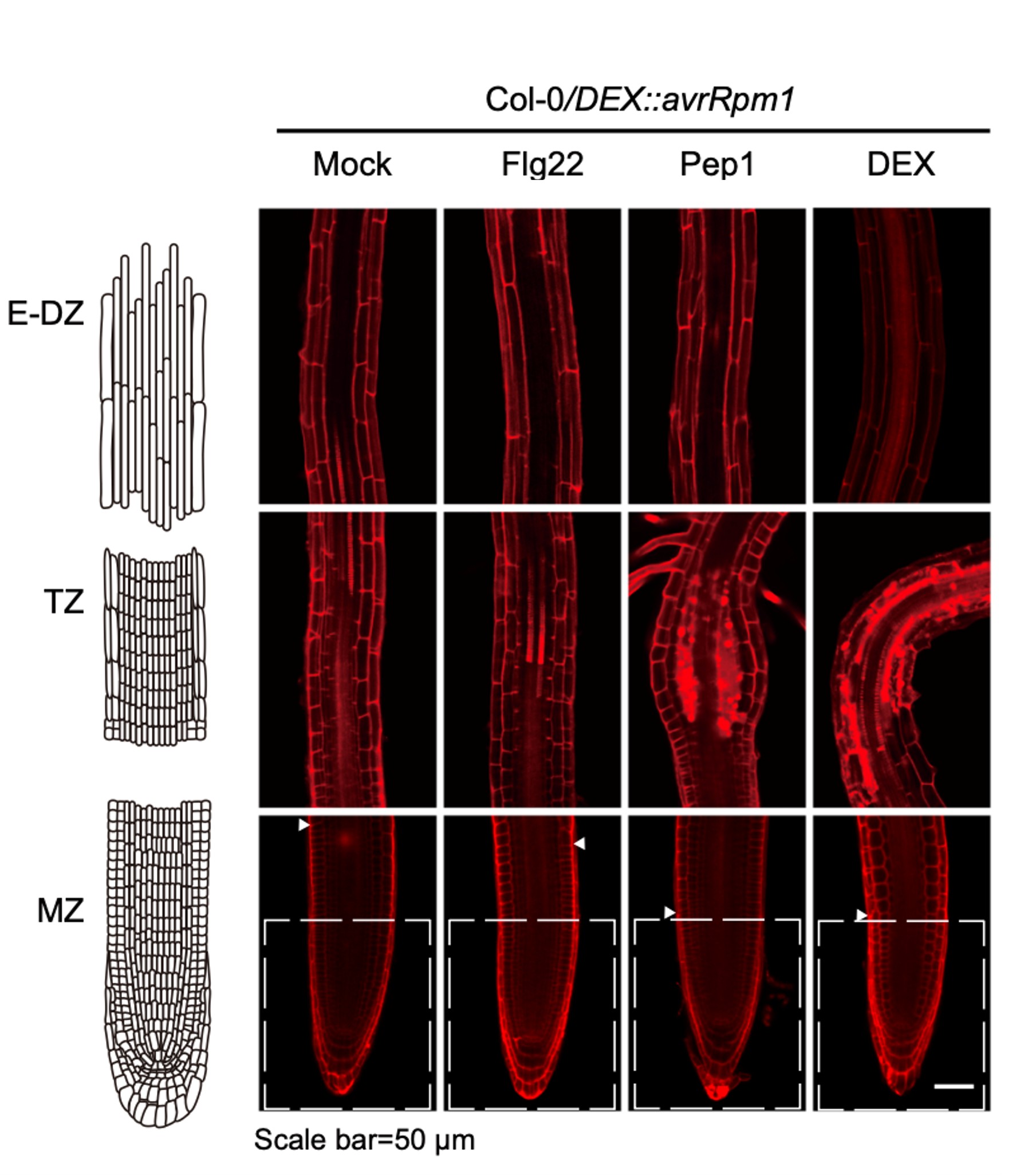 Plant immunity has two well-studied layers: pattern-triggered immunity (PTI), activated when plasma membrane-localized receptors recognize microbe-associated molecular patterns (MAMPs), and effector-triggered immunity (ETI), mediated by intracellular nucleotide-binding leucine-rich repeat (NLR) receptors that detect pathogen effectors. Both layers have been studied extensively in leaves, but roots, which are constantly exposed to complex soil microbiota, remain far less explored, particularly for ETI. Tang and colleagues used inducible effector-expressing lines to characterize root ETI and test its relationship to PTI components and the root microbiome. Compared to shoots, ETI activation triggered a weaker response in roots as evidenced by fewer differentially expressed genes (DEGs) and cell death restricted to the transition zone. Transcriptional profiling revealed that ETI-induced DEGs overlap ~45% with those induced by the MAMP flg22 (flagellin peptide 22) in shoots, but only ~16% in roots. Conversely, in roots there was ~43% overlap with genes induced by Pep1, a damage-associated peptide, versus ~26% in shoots. Similar to the role of PTI receptors in leaf ETI, the Pep1 receptors PEPR1 and PEPR2, along with receptor-like cytoplasmic kinase BIK1 and transcription factor WRKY42, were required for several root ETI outputs, though PEPRs were dispensable for leaf cell death. ETI also increased microbial load and reshaped the root microbiome by enriching bacterial families including Azospirillaceae and Caulobacteraceae. Together, these findings suggest roots exhibit a restrained and spatially confined ETI that leans more on damage signaling than MAMP signaling. (Summary by Aditi Bhat @jumpy_botanist) Nature Comms10.1038/s41467-026-76375-w