How plants evolved to integrate light and temperature
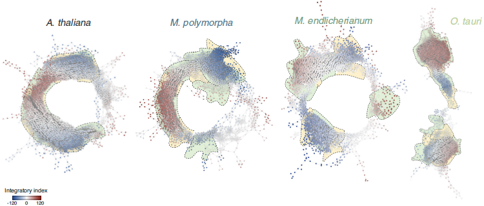 A recent study from Miguel Blázquez´s lab addressed the question of how plants integrate light and temperature information through a comparative analysis of four plant lineages, from algae to flowering plants. Catarino et al. compared Ostreococcus tauri (a chlorophyate alga), and three streptophytes, Mesotaenium endlicherianum (an alga), Marchantia polymorpha (a bryophyte), and Arabidopsis thaliana (an embryophyte). The authors combined phenotyping with transcriptomic analyses and found that light and temperature had a stronger combined effect on growth in streptophytes, while in O. tauri, their effects were mostly independent. These results suggest that the integration of environmental signals became more elaborate during streptophyte evolution. Using genetic analyses in M. polymorpha and A. thaliana, the researchers identified phytochromes (PHY) and the transcription factors PHYTOCHROME INTERACTING FACTOR (PIF) and ELONGATED HYPOCOTYL 5 (HY5) as conserved regulators of light‑temperature integration. However, the genes regulated downstream are substantially different between species. HY5 and PIF have similar DNA-binding preferences, but their binding sites are distributed differently across gene promoters. This suggests that changes in cis-regulatory elements can explain why plants from different lineages respond in a different way to light and temperature. In summary, this study shows how plants can keep some key regulatory components while developing different responses to the same environmental signals. Understanding how these regulatory networks have changed during evolution could help us better understand how plants adapt to their environment. (Summary by Adrian Gonzalez Ortega‑Villaizan @adrigov98 @adrigov.bsky.social). Proc. Natl. Acad. Sci. USA 10.1073/pnas.2601574123