High-Temperature-Induced Juice Sac Cell Wall Remodelling in Citrus Fruit
We are putting our spotlight in this section on how high temperature rewires cell wall biosynthesis in citrus juice sacs, ultimately driving a physiological disorder known as juice sac granulation. Specifically, we wanted to uncover how heat regulates the production of cellulose and hemicellulose, the major structural polysaccharides that strengthen plant cell walls.
Juice sac granulation is a common and economically damaging disorder in citrus production. Affected fruit appear perfectly healthy from the outside, but inside, the juice sacs gradually turn firm, opaque, and dry, leading to a substantial loss of quality and market value. While previous studies have linked granulation to excessive accumulation of cell wall materials, the underlying regulatory mechanisms have remained elusive.
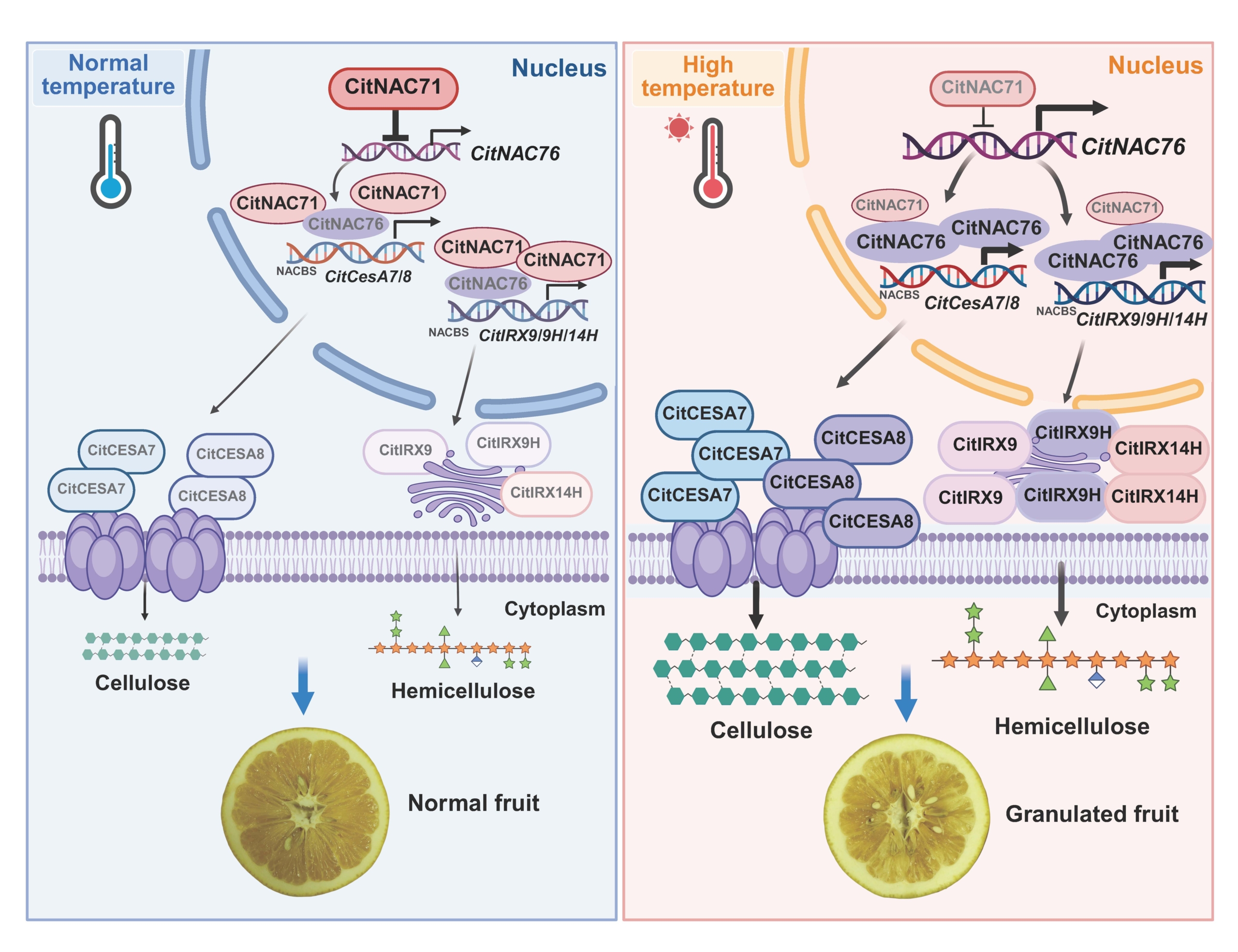
To address this, we developed a simple in vitro culture system for citrus juice sacs, enabling continuous monitoring of granulation under controlled temperatures. Using this system, we identified high temperature as a potent trigger of granulation. Through integrated transcriptomic, biochemical, and genetic analyses, we found that high temperature rapidly stimulates the production of cellulose and hemicellulose, making cell wall reinforcement one of the earliest events in the granulation process. Our findings further reveal that two NAC transcription factors co-operate to orchestrate this response. CitNAC76 acts as an accelerator, activating genes involved in cellulose and hemicellulose biosynthesis, while CitNAC71 serves as a molecular brake, repressing CitNAC76 both transcriptionally and via direct protein-protein interaction. Together, these regulators form a temperature-responsive molecular switch that fine-tunes cell wall biosynthesis during fruit development under heat stress.
The accompanying figure illustrates this regulatory model. Under normal temperatures, CitNAC71 keeps cell wall biosynthesis in balance, preserving healthy, translucent juice sacs. Heat releases this molecular brake, triggering excessive cell wall deposition and the onset of granulation. But how does high temperature switch this pathway on? Future work combining chromatin accessibility, epigenetic profiling, and transcription factor occupancy will help uncover how citrus fruit translates heat signals into changes in cell wall construction and fruit quality.
Original paper: https://doi.org/10.1093/plcell/koag197
Written by: Chen Kang (@chenkang-oxford.bsky.social), Laboratory of Fruit Quality Biology, Zhejiang University, China.
Edited by: Indrani Kakati (@indranik333; @indranik18.bsky.social), 2026 Plantae Editor