Herbivore bites promote plant growth in the succeeding year
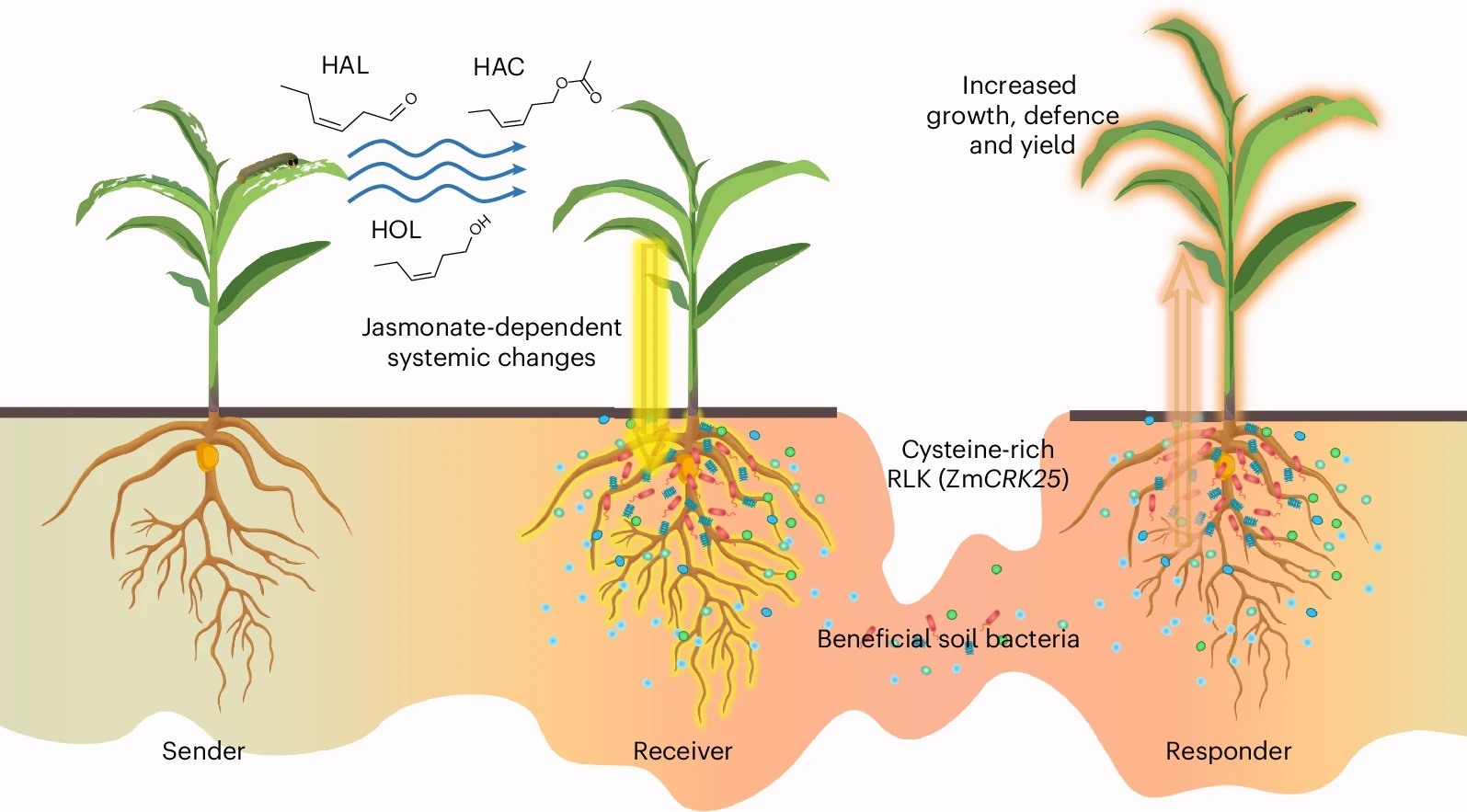 In Chinese, there is an old poem suggesting that livestock bites promote crop yield in the succeeding year. In this new work, Hu et al. provide evidence to support the traditional wisdom and propose the mechanism behind it. Previous studies showed that herbivore bites on leaves induce the release of volatiles, which activate jasmonate-dependent signalling in neighbouring plants and promote their immunity. The current study by Hu et al. suggests that the volatiles also promote plant growth in the succeeding year. The induced jasmonate-dependent signalling in the neighbouring plants alters rhizospheric microbiome structure to bring forth the lasting effect on plant growth through a process known as plant-soil feedback (PSF). The authors isolated the enriched rhizospheric microbes and showed that the microbes promote plant growth by reprogramming gene expressions in the roots. Using maize as the model, a plasma membrane-localized cysteine-rich receptor-like protein kinase (ZmCRK25) in root was identified as the mediator of the PSF. In addition to maize, such a PSF was also demonstrated in other crops including wheat, barley, rice, and tea. Providing a new insight, the current study shows that herbivore bites on leaves and the subsequent jasmonate-dependent signalling induced in the neighbouring plants can drive PSF, expanding the spatial and temporal dimensions of plant-plant interaction studies. (Summary by Yee-Shan Ku @YeeShanKu1) Nature Plants 10.1038/s41477-025-01987-x