GOOSE: A new tool to decipher the biological functions of intrinsically disordered regions
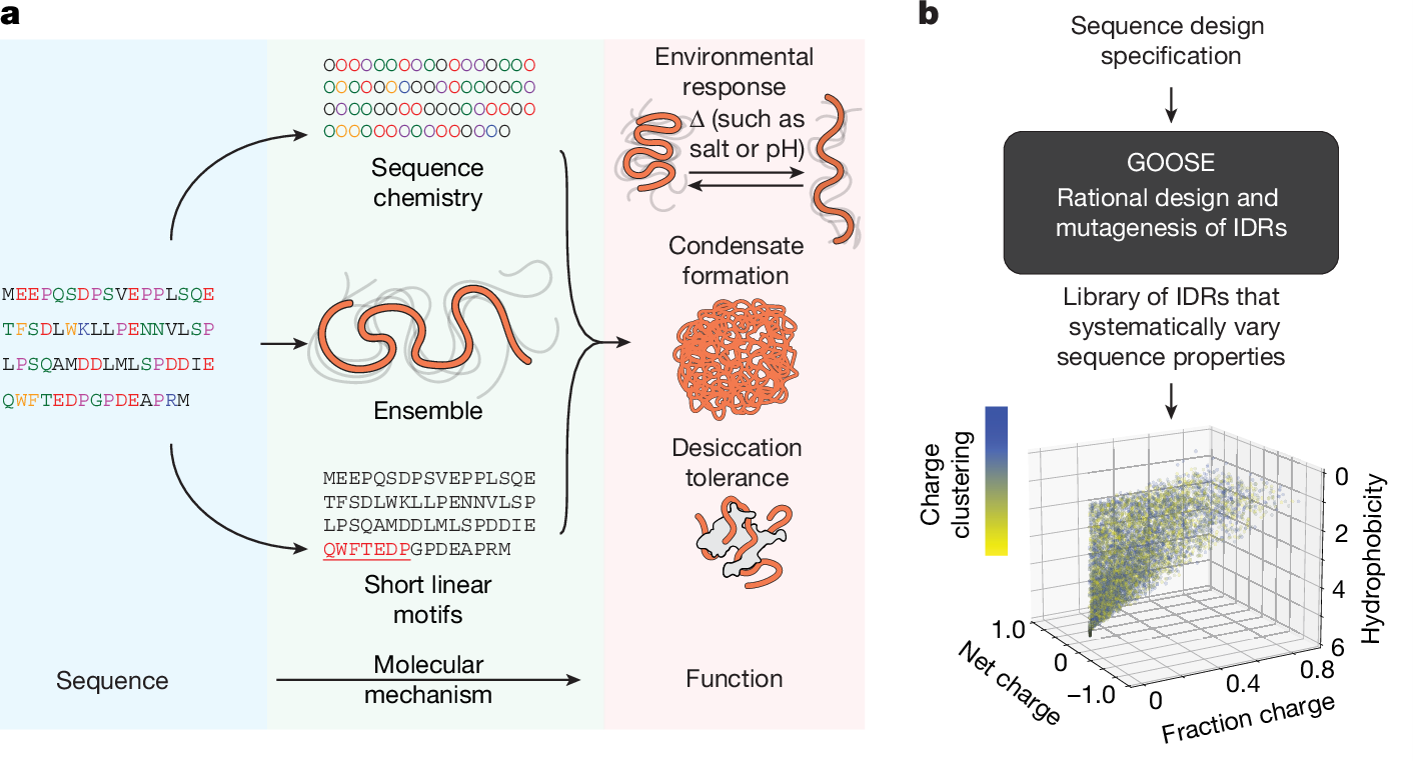 Protein domains lacking a rigid structure, known as Intrinsically Disordered Regions (IDRs), play important roles in many cellular processes, including protein quality control, protein-protein interactions, and subcellular localization. However, we know little about how the properties of IDRs are linked to protein functions. Hunter et al. developed a holistic approach to study these relationships. They introduced GOOSE, a computational framework for rational design of synthetic IDRs with diverse properties. GOOSE enables library-scale design in yeast, allowing the massive generation of mutants to investigate how IDRs link to specific protein functions. As an example, they showed that expanded and compact versions of IDRs of the same length can be generated by varying the distribution of charged residues within the sequence, with the compact IDRs exhibited greater nuclear localization. Moreover, they generated IDRs with attractive or repulsive self-interactions, as well as scaffold IDRs that selectively recruited specific client IDRs while excluding others, demonstrating that IDR sequences can control intracellular assembly and specific molecular interactions. Interestingly, IDRs with high alanine content, lower hydrophobicity, increased helical propensity and weaker self-interactions were also found to improve cell survival during desiccation, like functional desiccation-protective proteins. Overall, the study shows how GOOSE can design disordered proteins for case studies and uncover which sequence features are linked to biological functions, paving the way for a better understanding of the roles of IDRs across organisms. Summary by Fengoula Avgeri (https://x.com/AvgeriF), Nature (10.1038/s41586-026-10849-1 )