
Generating giant starch granules in wheat
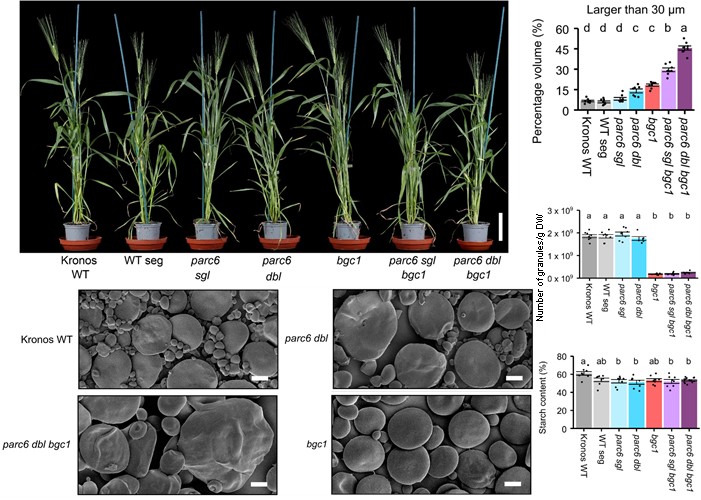 Large, A-type starch granules are desirable for nutritional and industrial purposes due to their gelatinization properties. However, the average wheat starch granule is small (less than 30 µm) compared to other starchy crops like pea and potato. Natural wheat cultivars with large granules have not been identified, necessitating the generation of a novel cultivar. McNelly and colleagues hypothesized that larger starch granules would accumulate if amyloplasts size was increased and/ or the number of new starch granule initiations was reduced. They isolated single mutants of two known factors involved in amyloplast division and starch granule initiation, PARALOG OF ARC6 (PARC6) and B-GRANULE CONTENT 1 (BGC1), respectively, and generated double mutants. Phenotypic analysis showed that the single and double mutants did not differ much from wild type (WT) in plant size, yield, or grain morphology. The double mutants had significantly more large granules (greater than 30 µm) compared to both the single mutants and WT lines but fewer granules overall, suggesting that increased starch granule size in mutants compensates for the large number of smaller granules in the WT. Future research will reveal whether the irregular surface microstructure and altered pasting properties (physical properties associated with the industrial uses and food texture of starch) of large starch granules from the double mutant will benefit milling efficiency and the quality of food products. This article describes a novel genetic combination to increase starch granule size that was previously unavailable in wheat or other cereals. Summary by Iris Mollhoff (@iris.mollhoff) Sci. Adv. 10.1126/sciadv.aeh2735