Every leaf has its own timeline: Advances in plant aging
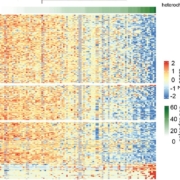
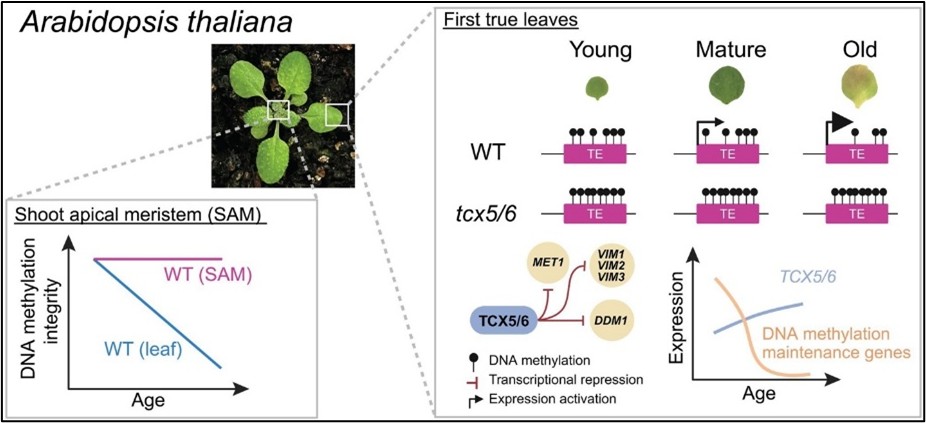 In humans and several mammals, the alterations in DNA methylation are a critical aging biomarker also known as the ‘Epigenetic Clock’. In this study by Dai et al., the authors examined the process of DNA demethylation in Arabidopsis plants to identify if this molecular marker of aging functions similarly as in animals. They observed that as the plants grow old these epigenetic markers slowly disappear. The authors report a delay in DNA demethylation when the plants are grown in short-day conditions. By comparing the methylomes in various plant tissues, the authors report that the SAM does not exhibit any signs of aging and is devoid of epigenetic markers which are otherwise common in older senescent leaves. The authors also studied the transcriptomes of the first true leaves in wild-type plants over an aging time course. They recognized two differentially regulated genes, TCX5 and TCX6, that drive the epigenetic decay in older leaves by repressing DNA methylation maintenance genes. When the authors examined the leaves of the mutant tcx5/6, they found that although the DNA methylation is steadily maintained, it does not stop the leaves from following the usual time course of senescence. As fascinating as it would be to stall or reverse aging, the authors show that epigenetic alterations are a ‘product’ rather than a ‘driver’ of aging in plants. (Summary by Sonal Sachdev sci3ntyst , sci3ntyst.bsky.social) Science 10.1126/science.adu2392